Ever feel like Sachse has “inside stories” you don’t get until you’ve been here a while?
You’re not imagining it. Sachse’s landmarks, roads, and routines make a lot more sense once you know why they’re there—and how the city grew up around them.
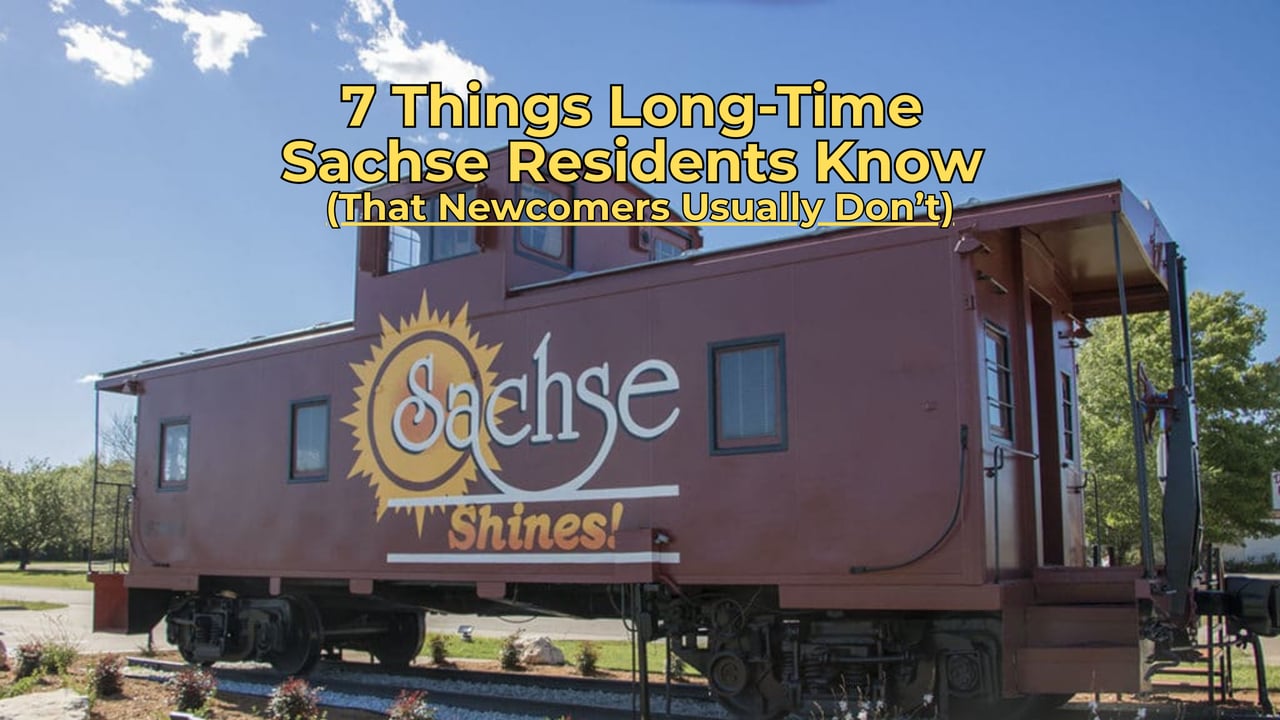
1) The caboose isn’t just cute—it’s a “how we got here” museum piece
If you’re new, you might see the caboose and assume it’s just a photo-op. Long-time residents know it’s a symbol of the city’s origin story—and a community project that’s evolved over time.
According to the Sachse Historical Society, the Union Pacific caboose was pulled from a railroad car “graveyard” in Longview and later served multiple roles: the Sachse Chamber of Commerce, then a business library, then sat vacant for years. In 2016, the Historical Society worked with the city to repurpose it as an extension of the museum—specifically to teach how railroads created towns like Sachse.
Why it matters to you: when you understand the caboose, you understand Sachse: a small-town identity shaped (and sometimes squeezed) by big infrastructure.
2) That “original” water-tower corner tells you how small Sachse used to be
Old-timers remember when Sachse felt like a few key intersections—and one of the most iconic was the water-tower area near 5th Street and Sachse Road, with municipal services historically clustered nearby (locals still refer to it as the “old city hall area” in everyday conversation).
Even today, city planning and capital project documents still reference ongoing work tied to the “5th Street Water Tower”—it’s literally a named item in city budgeting and infrastructure planning.
Why it matters to you: if you want to understand where Sachse’s “center of gravity” started—and why the city is intentionally building a more walkable downtown vibe near 5th Street—this is the clue.
3) The railroad is the reason Sachse exists… and why the city layout can feel “pinched”
Sachse didn’t just happen—it was effectively negotiated into existence.
The City of Sachse’s history notes that in 1886, William Sachse gave right-of-way through his holdings to the railroad, and in exchange, the railroad built a depot and named the town. The Handbook of Texas also describes Sachse’s formal establishment in 1886, tied to a rail station naming agreement.
But here’s the longtime-resident part: rail can be both a backbone and a bottleneck. Tracks tend to create hard edges—limited crossing points, traffic backups when trains roll through, and “two sides of town” feelings during peak hours.
Why it matters to you: once you see the tracks as a historic boundary line, the city’s road patterns and development choices make a lot more sense.
4) “Sachse schools” didn’t start as districts—they started as a couple of buildings (and a lot of adaptation)
New residents often assume the school footprint has always been what it is now. Long-time residents know the story is more patchwork—and it goes back a long way.
The city’s history summary notes:
-
The first school in Sachse was built by the State of Texas at Sachse Road and Billingsley Street.
-
A later school was built at Third and Dewitt in the early 1900s, and a red-brick schoolhouse followed in the 1920s.
-
By the 1940s, Sachse consolidated with Garland ISD, with students bused to Garland.
Fast-forward to modern growth: Sachse High School (Garland ISD) opened in 2002, marking a major “we’re growing up” moment for the city. Wylie ISD schools followed later across the northern reaches of Sachse as development continued outward.
Why it matters to you: understanding this timeline helps you see why school zones, feeder patterns, and growth conversations have been such a consistent theme in Sachse for decades—because the city has been expanding in waves, not in a straight line.
5) When Kroger arrived, it didn’t just add groceries—it changed how people “used” Sachse
Before major retail anchors, small cities tend to “export errands.” Long-time residents remember when you’d often drive elsewhere for a full shopping run.
Oak Grove Plaza—anchored by a Kroger Signature store—became a big shift. Reports show it was built in 2003 and anchored by Kroger, indicating confidence that Sachse could support destination retail.
Why it matters to you: that store wasn’t just “a store.” It was a confidence marker—proof Sachse could support destination retail, which tends to pull in more services and pads the way for additional development.
6) Life before the President George Bush Turnpike was… a different pace (and a different commute map)
If you moved here with the Turnpike as a given, you inherited a major advantage without feeling the contrast.
The President George Bush Turnpike was established in the late 1990s, with segments opening in phases—including the Garland/Richardson section in 2000—which drastically improved regional mobility.
Why it matters to you: connectivity changes growth, and since the Turnpike arrived, Sachse hasn’t looked back.
7) The “oldest business in Sachse” depends on how you define it — and a couple of historic names stand out
Ask five long-time residents and you might get five answers—because people define “oldest” differently (oldest building, oldest continuously operating, oldest family-owned, etc.). But a few names tend to pop up again and again:
-
Sachse Rod Shop — Since 1982, this hot rod and custom car shop has been turning wrenches, building and restoring cars in the same spot and serving enthusiasts across the Dallas metroplex.
-
Odie Hall Real Estate — One of Sachse’s most storied local brokerages, founded by Odie Hall in 1962 and deeply rooted in the community’s growth and real estate heritage.
-
Ted’s Floor & Decor — Operating from the same location since 1976, it’s another frequently mentioned legacy business (still running on its original site).
Why it matters to you: in a city that’s grown fast, these long-running local businesses are like living history. They’re the places where generations of residents have spent money, swapped stories, and watched the city change in real time.
Final takeaway
When you learn these “insider” details, Sachse stops feeling like a random suburb on a map—and starts feeling like a town with a clear origin story: railroad roots, infrastructure turning points, and a steady evolution from rural crossroads to growing city.
If you’re new to Sachse (or you’re relocating within the city), you don’t have to learn the “locals-only” details the slow way. If you want help finding a neighborhood that fits your day-to-day life—or you’re curious how future development might affect property values on your street—reach out and I’ll help you map it out.