
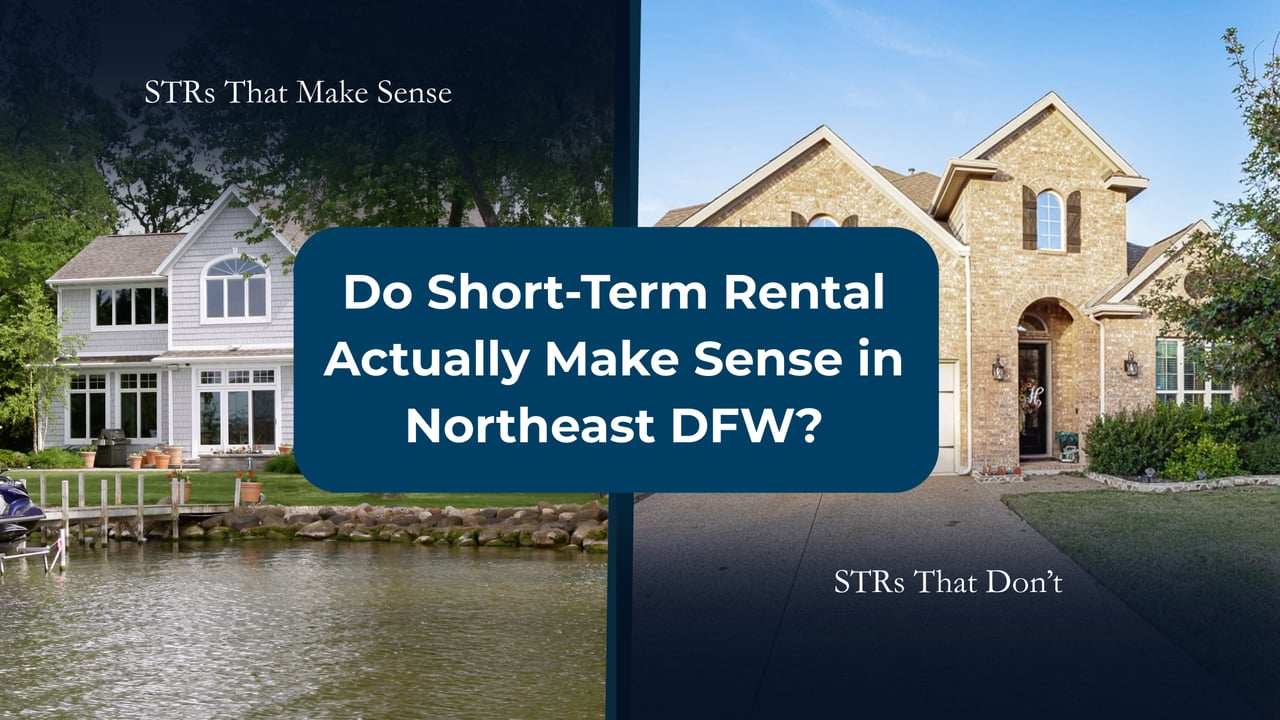
If you’re looking at short-term rentals (30 days or less) in the northeastern part of the Dallas–Fort Worth metroplex, here’s the blunt truth: unless the property is directly tied to Lake Ray Hubbard, most STRs don’t pencil well—and they often create more neighborhood friction than upside.
You’re not anti–Airbnb. You use them yourself. But there’s a difference between destination-driven STR markets and bedroom-community suburbia. And cities like Sachse, Wylie, Murphy, and Lavon are increasingly legislating as if they agree with you.
Let’s break down why this matters, how local ordinances are shaping outcomes, and what the future likely holds.
Why STRs Struggle in Northeast DFW Suburbia
Before ordinances even enter the conversation, demand fundamentals matter.
In areas like Broken Bow, New Orleans, or San Diego, guests arrive because of the location. In most of Northeast DFW, guests arrive despite the location—usually because hotels are full, someone is visiting family, or they need temporary housing.
That creates three structural problems:
-
Inconsistent demand (weekend-only or event-based)
-
Price sensitivity (guests won’t pay resort premiums)
-
Neighborhood impact (guests behave like tourists in non-tourist areas)
Outside of lake-adjacent pockets of Lake Ray Hubbard, STRs tend to feel intrusive rather than additive.
City-by-City: How Local Ordinances Are Pushing Back
Sachse
Sachse has implemented a rental registration program, requiring owners to formally register rental properties with the city.
What this signals for STRs:
-
The city is prioritizing accountability and traceability
-
Even without a standalone STR license today, enforcement pathways are now clearer
-
This is often the first step toward stricter STR-specific regulation
Sachse isn’t encouraging STR growth—it’s laying groundwork to manage or limit it.
Wylie
Wylie’s zoning code strongly emphasizes owner-occupied lodging models, such as traditional bed-and-breakfasts.
Why that matters:
-
Whole-home, absentee STRs don’t cleanly fit existing use definitions
-
Enforcement typically occurs through zoning interpretation and nuisance rules
-
This creates uncertainty—one of the biggest risks for investors
Markets with unclear rules tend to become hostile markets by default.
Murphy
Murphy is the most explicit: STR permits are required, they are non-transferable, and owners must designate a local responsible party.
Translation:
-
STRs are tolerated, not welcomed
-
Compliance costs and operational friction are intentional
-
Any property sale resets the clock
Murphy’s framework is designed to discourage casual STR ownership.
Lavon
Lavon formally defines short-term rentals and applies hotel occupancy taxes, along with broader rental inspection authority.
What this tells you:
-
The city views STRs as a lodging business, not a housing solution
-
Inspections and taxation reduce margins
-
Regulatory oversight will likely increase, not decrease
Lavon is aligning itself with more regulation as growth continues.
Why Lake Ray Hubbard Is the Exception
Properties on or directly adjacent to Lake Ray Hubbard operate under a different demand model:
-
Boating and lake recreation
-
Seasonal weekend travel
-
Group stays that value space over hotel rooms
Here, STRs behave more like destination rentals, not housing substitutes. That distinction matters—to guests, neighbors, and city councils alike.
In practice:
-
Fewer complaints
-
Higher willingness to pay
-
Clearer justification for short stays
This is the only part of Northeast DFW where STRs consistently align with market logic.
Are STRs Bad for Home Values?
The research shows mixed outcomes, and context matters.
At a high level:
-
STR activity can increase property values by introducing investor demand
-
But that effect weakens—or reverses—at the neighborhood level when STRs are perceived as disruptive
In suburban markets, the more common outcome is:
-
Reduced buyer appeal for owner-occupants
-
Longer days on market for homes near poorly managed STRs
-
Pressure on cities to “do something,” which usually means regulation
In other words, STRs may help individual sellers in the short run—but hurt neighborhood stability over time.
What’s Coming Next: Cities and the State of Texas
At the City Level
Expect:
-
More registration requirements
-
Clearer zoning prohibitions
-
Permit caps or spacing rules
-
Stronger nuisance enforcement
Cities rarely reverse course once regulation begins—they refine it.
At the State Level
The Texas Legislature has historically protected property rights, but it has not eliminated local control over STR regulation.
The likely future:
-
Continued allowance for cities to regulate STRs
-
No sweeping statewide preemption
-
Incremental adjustments, not investor-friendly rollbacks
In short: don’t expect Austin to “save” suburban STRs.
The Bottom Line
Your instinct is sound.
Short-term rentals rarely make sense in Northeast DFW suburbia unless they are clearly tied to Lake Ray Hubbard. Elsewhere, they tend to:
-
Underperform financially
-
Create neighborhood tension
-
Attract increasing regulatory pressure
If you’re evaluating investment strategies in this part of the metroplex, mid-term rentals (30+ days) or traditional long-term leasing are usually better aligned with both market demand and municipal priorities.
Final Takeaway
Just because STRs can exist doesn’t mean they should. In Northeast DFW, cities are quietly—but clearly—signaling that stability matters more than short-term arbitrage.
If you’re weighing an investment property in Sachse, Wylie, Murphy, Lavon, or near Lake Ray Hubbard and want an honest, regulation-aware perspective, let’s talk before you buy. The wrong strategy can get expensive fast.