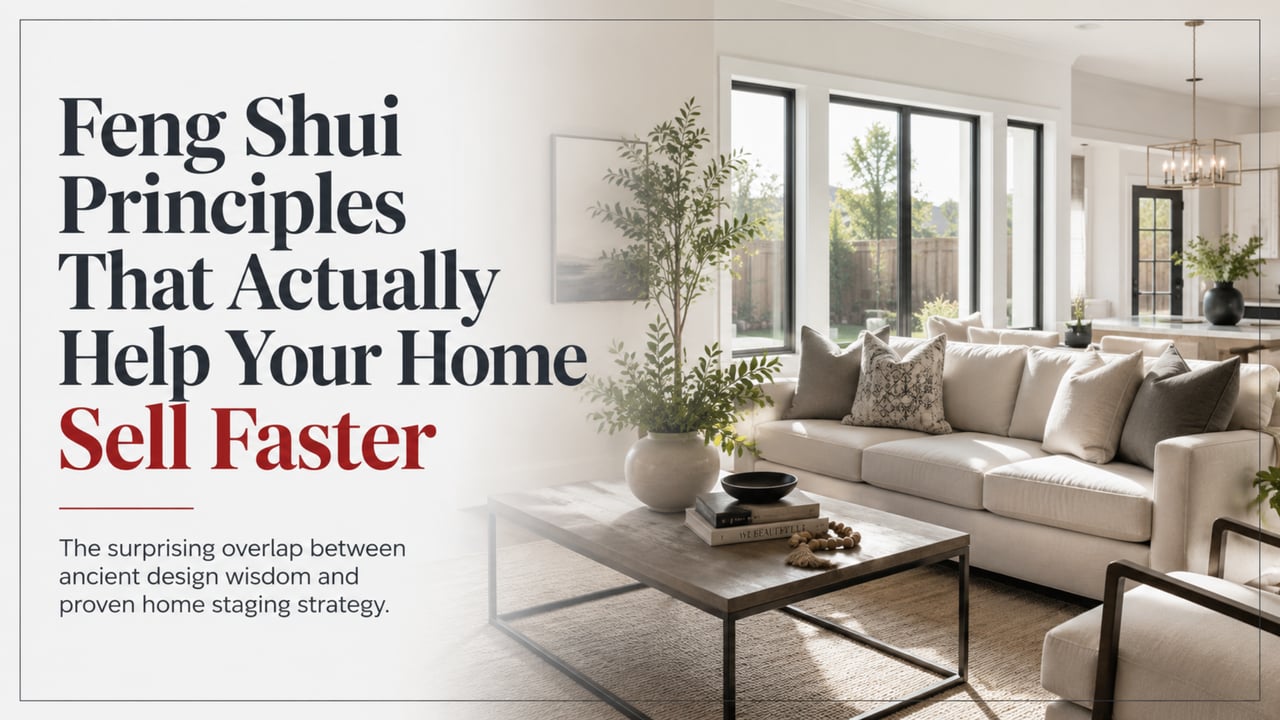
Can feng shui help you sell your home faster? The principles behind it (clear flow, abundant light, minimal clutter and intentional furniture placement) overlap almost exactly with what professional staging research says makes homes sell quicker and for more money.
You don't have to burn sage or consult a bagua map to take something useful from this post. I'm not a feng shui practitioner. I'm a real estate broker who has walked through thousands of homes across Sachse, Wylie, Murphy, Lavon and Royse City and I've noticed patterns.
The homes that sell fast and photograph well share certain qualities. They feel open. They feel light. You can walk through them without weaving around furniture. They don't make you anxious. And when I started looking at what feng shui actually teaches, I found that a practice developed thousands of years ago in ancient China was describing the same conditions, just with different language.
Make of that what you will. I'm going to focus on the part that helps you sell your house.
What Feng Shui Is (The 30-Second Version)
Feng shui is the Chinese practice of arranging spaces to promote the flow of qi, or life energy. The core idea is that the way a space is arranged either supports or obstructs that flow, which in turn affects the people who live in it.
Whether or not you subscribe to the energy piece, the underlying framework (flow, light, proportion, nature, clutter) maps almost perfectly to what staging professionals and real estate photographers will tell you makes a home show well. The overlap is too consistent to ignore.
Here are the principles worth paying attention to before your listing goes live.
1. Clear the Entry (The "Mouth of Qi")
In feng shui, the front door is where energy enters the home. In real estate, it's where buyers form their first impression. These are not different things.
A buyer standing at your front door in those first ten seconds is deciding whether the house feels welcoming or not. If the path is blocked by an overgrown shrub, the door hardware is corroded, the mat is worn out or the light fixture is flickering, that impression is already compromised.
Fix it before anything else: fresh paint on the door, working hardware, a clean mat, clear sightlines from the street to the entry. This is the highest-return prep item on the list, and it costs almost nothing.
2. Clear the Clutter (Because Clutter Blocks Everything)
Feng shui says clutter obstructs the flow of qi. Staging says clutter prevents buyers from being able to see and mentally inhabit the home. The result is the same: remove it.
This means countertops, closets, garages and every surface that has become a landing zone over the years. If you've ever watched a buyer open a packed closet and physically back up, you've seen the problem. For a deeper look at the kitchen side of this, the post on clearing kitchen counters before a showing is worth reading. For closets, there's a full guide there too.
The short version: if you don't love it, use it or need it in the next 60 days, pack it or donate it now.
3. Let In the Light
Light is energy in feng shui. In real estate photography, it's everything.
Open every blind and curtain for showings. Clean your windows inside and out before photos are taken and if you're in North Texas, you know that dust is relentless. Grimy windows are one of the most common issues I see in listing photos and it's a completely avoidable one.
In rooms that don't get much natural light, mirrors are your friend. A well-placed mirror bounces light around a space and makes it feel larger. This is a feng shui staple. It's also a staging staple. Add one.
4. Create Clear Pathways
In feng shui, furniture that blocks doorways or the natural path through a room is considered an obstruction. In real estate, it just makes rooms feel smaller and harder to photograph.
The fix is usually simpler than people expect. Pull furniture slightly away from walls instead of pushing it all back. Create conversational groupings that make sense for how the room is actually used. Make sure someone can walk through each room without navigating around a chair leg or a side table.
This matters even more in North Texas, where newer builds in Sachse, Wylie, Murphy and Lavon often feature open-concept floor plans. Those layouts are actually ideal for feng shui flow principles, the challenge is furnishing them in a way that creates visual definition without blocking movement. If you've filled a large open space with furniture pushed to the perimeter, try grouping it instead. The room will feel more purposeful and photograph better.
5. Balance the Bedroom
Feng shui treats the bedroom as a space for rest and restoration and it emphasizes symmetry: matching elements on each side of the bed, a calm environment, minimal visual noise.
Staging says the same thing. Matching nightstands on both sides of the bed photograph better and make the room feel more finished. Neutral, hotel-style bedding reads well in photos and feels aspirational without being personal. Nothing under the bed (you'd be surprised how often this shows in photos). No laundry, no stacked books, no clutter on the nightstands.
The television debate is real: feng shui discourages TVs in the bedroom entirely. Staging says at minimum, hide the cords and remove it from the visual focal point if possible. Do what you can.
6. Bring Nature In
This one is practical and makes a real difference in photos. Natural materials (wood, linen, stone, live plants) photograph warmly and make a space feel alive rather than staged.
A simple potted plant on a kitchen counter, a wood cutting board leaned against a backsplash, a linen throw on a sofa. These are small additions that read as "someone actually lives well here."
One firm rule: remove any dead or dying plants immediately. They're worse than no plant at all. If you can't keep something alive through the listing period, choose a realistic succulent or skip it.
7. The Command Position
In feng shui, the bed, desk and primary sofa should ideally face the door — not be tucked against it or turned away from it. This is called the command position and the idea is that it places the occupant in a position of awareness and ease.
In staging terms, this is just intentional furniture arrangement. Rooms where furniture is pointed toward the entrance feel more deliberate. Rooms where you walk in and see the back of a sofa feel disjointed. It's a subtle thing, but buyers feel it even when they can't name it.
The Bottom Line
Whether this is ancient wisdom or practical common sense, the overlap is hard to ignore. A home that flows well, feels light and has clear pathways does sell faster. The National Association of Realtors' staging research consistently shows that staged homes spend less time on the market. The feng shui framework arrives at the same conclusion from a completely different direction.
You don't have to believe in qi to make your home show better. You just have to clear the entry, let in the light and move the furniture so someone can walk through the room without turning sideways.
FAQ
Does feng shui actually help sell a home faster? Not directly, but the principles feng shui emphasizes (clutter-free spaces, good lighting, clear pathways and balanced furniture placement) align closely with what real estate staging research identifies as factors that reduce days on market. The practical overlap is what matters.
What's the most important feng shui principle to apply before listing? Clear the entry first. The front door and the immediate interior create the first impression buyers carry through the entire showing. Fresh hardware, a clean path, good lighting and zero clutter at the entry sets the tone for everything that follows.
Are open floor plans easier or harder to stage using these principles? Generally easier, because open plans don't have walls and doorways blocking natural flow. The challenge is creating visual definition through furniture groupings rather than relying on walls to do that work. Newer homes in Sachse, Wylie, Murphy and Lavon tend to have this layout, and it's actually a natural advantage when staged intentionally.
Thinking about listing your home in Sachse, Wylie, Murphy, Lavon or the surrounding area? Jeanie Marten Real Estate can walk through your home before it hits the market and give you a specific prep list, not a generic checklist. Small changes in the right places make a real difference.
If you liked this blog, check out this one: I Don't Trust the Word "Luxury." Here's What Actually Matters in a High-End Home — a deeper look at the features that actually add value versus the ones that just sound impressive.