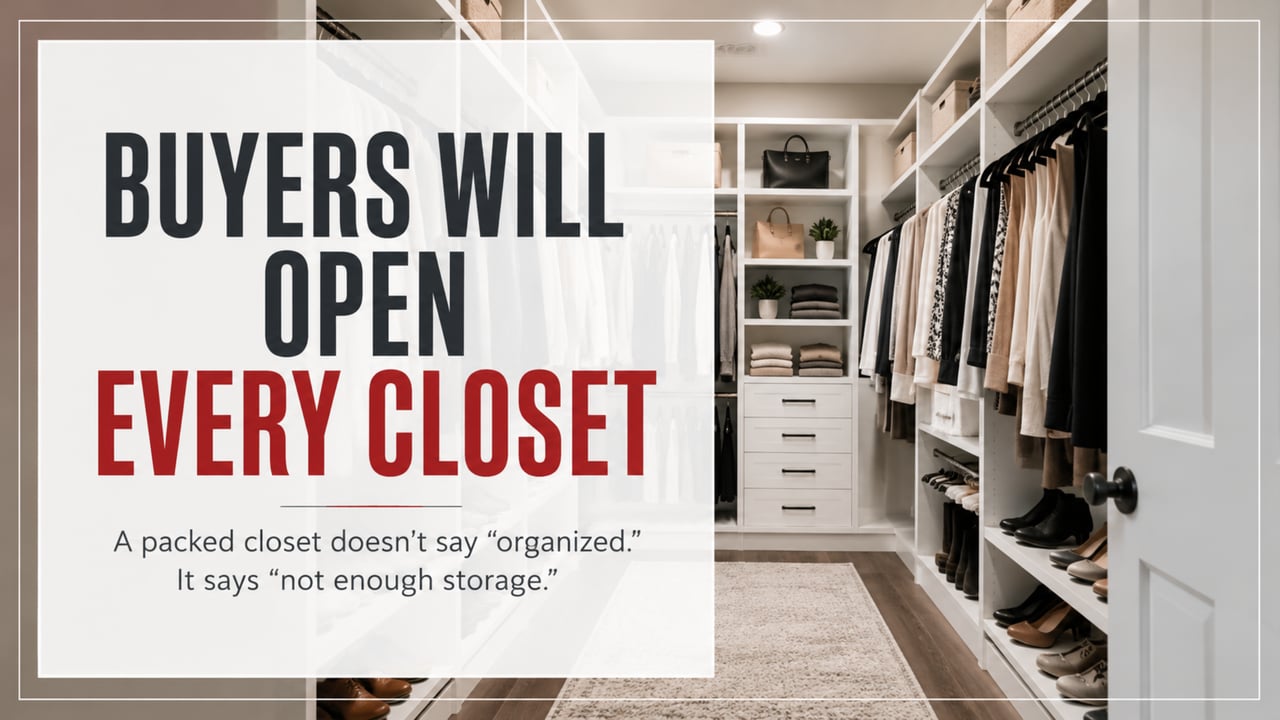
Should you organize your closets before listing your home? Yes, and here's the uncomfortable truth: buyers open every single closet during a showing and a stuffed closet signals "not enough storage" even when your home has plenty.
If you've already tackled your counters and surfaces (see our post on decluttering kitchen counters before listing), this is your next assignment. Closets. All of them.
Sellers in Sachse, Wylie and Murphy tend to underestimate how much time buyers spend inside a walk-in closet. They touch the shelves. They look at the floor. They're imagining whether their wardrobe fits. And if what they see is a wall of packed clothes, bins stacked to the ceiling and shoes piled in a corner, their brain registers one thing: this home does not have enough storage.
It doesn't matter if your closet is actually generous. If it looks maxed out, buyers feel it. And storage is consistently one of the top priorities for suburban North Texas buyers, especially in the 2,000-to-3,500-square-foot homes that make up most of the inventory in Sachse, Wylie, Murphy, Lavon and Royse City. Your closets need to tell the right story before the first showing.
Which Closets Matter Most (And in What Order)
Not all closets carry equal weight. Here's the hierarchy so you know where to spend your time first.
1. Primary Bedroom Walk-In Closet
This one gets the most attention. Buyers linger here. They open both sides, look at the rods, check the floor space. A well-organized walk-in is memorable in the best way.
Remove at least 30 to 40 percent of what's currently hanging. You should be able to see the back wall clearly and the floor should be fully visible. Off-season clothes go to storage, a portable pod or the garage. Pack up anything you haven't worn in a year.
Organize what remains by category and then by color if you can. It sounds fussy but it photographs like a magazine spread and buyers genuinely remember it. No shoes on the floor: use a simple shoe rack or clear bins. And spend $15 to $20 on a pack of matching velvet hangers from Target or Amazon. The difference between a closet full of mismatched wire and plastic hangers versus a uniform row of velvet ones is dramatic. Worth every penny.
2. Kitchen Pantry
The pantry door opens within the first two minutes of a showing. Buyers want to know it's functional and has room to grow.
Start by pulling expired items. It's always more than you think and clearing them out alone creates visible space. Then group like items together: canned goods in one area, snacks in another, baking supplies together. You don't need an elaborate organization system, a few simple bins or baskets from the dollar section are enough to make things look intentional rather than random. Face every label forward. It takes five minutes and the result looks like a pantry shoot from a home magazine.
3. Linen Closet
This one gets ignored until the last minute and it shows. Pull everything out. Edit down to what you actually use. Fold all towels and sheets the same way, in the same direction. Store like with like: all bath towels together, all sheets together by bed size. Buyers who open a linen closet and see neat stacks feel calm. Buyers who open one and see a cascade of mismatched everything feel the opposite.
4. Secondary Bedroom Closets
These closets are where buyers picture their guests or their kids. The standard to meet here is simple: they should look like they have room to spare.
Aim for no more than half full. If they're packed, buyers assume inadequate storage, full stop. Remove anything seasonal, any obvious junk and anything that would raise questions. What's left should look intentional and comfortable, not crammed.
5. The Garage
The garage storage situation is its own conversation and we'll cover it in a separate post. For now: if your garage is overflowing because you moved closet overflow out there, try to contain it neatly to one wall or section. Buyers who see an organized garage read it as a bonus. Buyers who see a chaotic one wonder what's wrong with the house.
The Staging Trick Most Sellers Miss
Empty closets can feel a little sad. Packed closets feel overwhelming. The sweet spot is "aspirational but livable."
Leave a few nice things visible. A neatly folded sweater on a shelf. A clean row of shoes on the rack. Matching hangers with your best basics. Buyers are not just evaluating square footage, they're imagining their life in your home. Give them something worth imagining. The National Association of Realtors' staging research consistently shows that staging affects buyer perception of home value and closets are no exception.
Think of it this way: the goal is not to look like no one lives there. The goal is to look like someone lives there really, really well.
A Note on North Texas Homes Specifically
Many homes built in Sachse, Wylie and Murphy since 2000 have generous closet space by design. Builders in this part of Collin County knew suburban families needed storage and they delivered it. The problem isn't the square footage, it's that sellers fill every inch and then wonder why buyers say the storage "feels small."
You have the space. The work is just showing it off. Clear the floor. Create breathing room on the rods. Let buyers see what they're actually getting.
For more on prepping your home before it hits the market, HGTV's home staging checklist is a solid starting point to layer alongside your closet work.
FAQ
Do buyers really open every closet during a home showing? Yes. Buyers open closets, cabinets, pantries and sometimes kitchen drawers. Storage space is one of the top decision factors in a home purchase, especially in suburban North Texas. Assume every closet will be opened and prepare accordingly.
How much should I remove from my closet before listing? For your primary walk-in, aim to remove 30 to 40 percent of what's in there. Secondary closets should look no more than half full. The goal is for buyers to see the space clearly, not to feel like it's already at capacity.
Is it worth buying organizing supplies before listing? You don't need an elaborate system. A pack of matching velvet hangers ($15 to $20), a few simple bins or baskets for the pantry and a basic shoe rack for the walk-in closet are the only purchases most sellers need. The return on those small investments is a closet that photographs well and sticks in a buyer's memory.
Ready to get your home market-ready in Sachse, Wylie, Murphy, Lavon or Royse City? Let's talk through what your home needs before it lists.