
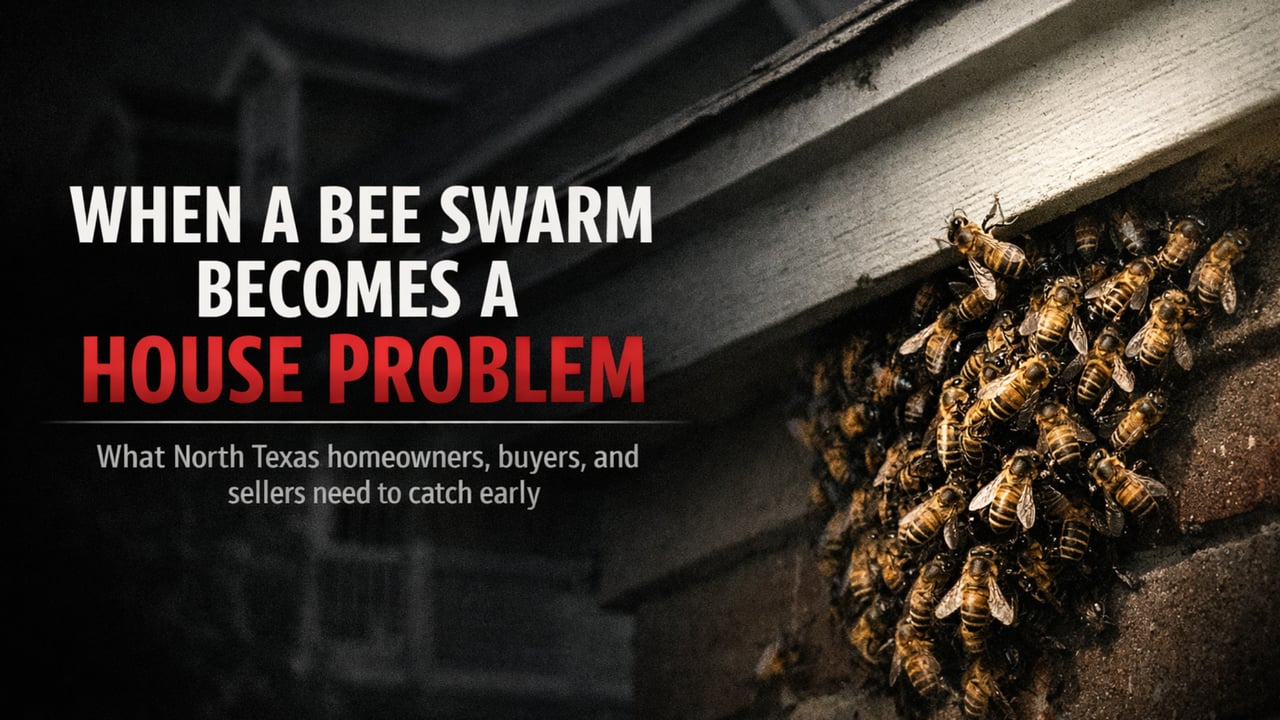
Have you ever seen a cloud of bees in a yard and wondered whether it was harmless spring activity or the start of a serious home issue?
In North Texas, bee swarms are most common from March through June, with April and May typically being the peak months. Most swarms are temporary, but if they find an opening into a wall, roofline, chimney, or floor system, a short-lived swarm can turn into an expensive hive-removal and repair job.
Why you see more bee swarms this time of year in North Texas
Spring is prime swarm season because that is when healthy colonies reproduce. Texas A&M AgriLife materials explain that reproductive swarms usually happen in spring when forage is plentiful, and local North Texas sources place the main swarm window from March to June, with the heaviest activity in April and May.
A swarm usually looks dramatic: thousands of bees flying, then clustering on a tree limb, fence, eave, or other resting spot while scout bees search for a permanent home. The good news is that a true swarm is often less defensive than an established colony because it has no stored food or immature bees to protect. The bad news is that if you ignore it near a structure, those bees may decide your home is the perfect cavity to move into.
My real-world experience after 30 years in North Texas real estate
In 30 years of doing this work, I have only seen three houses where bees had actually colonized the home itself. That sounds rare, and it is. But when it happens, it matters.
On one home I represented for a buyer, the inspector found a hive between the first and second floor. A beekeeper ultimately removed the hive and about 600 pounds of honeycomb. He sealed the area afterward and warned us not to trim the foam insulation he used for at least a year, because bees could return and other pests could go after any residue left behind.
On another home in Murphy, where I was the listing agent, the sellers had no idea there was an active colony until I pointed out the bee traffic. They called a local beekeeper, who removed the hive and about 15 pounds of honeycomb. The cost was about $300 to remove the hive and reseal the area.
Those stories are unusual, but the lesson is not: if bees move from “passing through” to “taking up residence,” the problem gets bigger, messier, and more expensive very quickly.
What a swarm means for homeowners
If you are a homeowner, the key question is not just “Are these bees dangerous?” It is “Are they moving on, or moving in?”
Foraging bees around flowers or water are common and usually not aggressive. A swarm clustered temporarily is also often low-risk if it is away from people and structures. But once bees enter a wall void, attic, soffit, chimney, or floor system, the issue changes from a bee sighting to a structural pest and repair problem.
Texas A&M AgriLife warns that failure to remove the nest itself can lead to odors, fermenting honey, staining, and follow-on pest problems such as ants, cockroaches, carpet beetles, wax moths, and rodents. Old comb can also attract bees back to the same area.
That matches what many North Texas removal pros say in practice: the real fix is not just getting rid of the visible bees, but removing the comb, cleaning out the cavity, and resealing entry points.
What it means for home sellers
If you are preparing to sell, spring is a smart time to pay attention to exterior bee activity. Texas A&M AgriLife recommends doing a regular “bee patrol” during swarm season and bee-proofing likely nesting sites by sealing holes in outside walls, screening openings, and reducing attractive cavities.
For sellers, this matters for two reasons. First, active bee traffic can scare off buyers before they even get to the front door. Second, if bees have colonized part of the house, removing them properly before you list is usually far better than having the issue discovered during inspection.
Texas sellers of previously occupied single-family homes are required to use the Seller’s Disclosure Notice, which TREC says covers material facts and the physical condition of the property. While the form does not call out bee colonies by name, a known hive inside the structure, along with related removal or repair work, is the sort of issue you should discuss with your broker and disclose accurately rather than hope no one notices. That is a practical compliance point, not individualized legal advice.
What it means for home buyers
If you are buying in North Texas during spring, a bee swarm should not automatically kill the deal, but it should absolutely slow you down and make you investigate.
A temporary swarm in a tree may be handled quickly by a qualified beekeeper. An established colony inside a wall or between floors is a different conversation. Once bees have built comb inside the house, removal can involve opening finishes, removing honeycomb, cleaning residue, resealing access points, and sometimes waiting for lingering activity to die down.
That is why inspections matter. If an inspector sees bee traffic at soffits, brick weep holes, siding gaps, or roof transitions, you want answers before closing. In some cases, the better solution is a licensed removal specialist plus repairs by the seller before the sale moves forward. In others, the buyer may negotiate credits or repairs. The right answer depends on where the colony is, how long it has been there, and how much comb has already been built.
What removal usually costs
Costs vary widely depending on whether you are dealing with a simple swarm or an established hive inside the structure.
Current national cost guides put professional bee removal at about $150 to $500 on average, with simple jobs starting lower and complex in-structure infestations reaching $2,000 or more. HomeAdvisor says the average is about $280, with complex removals going up to $2,000. Angi similarly says standard removal averages $150 to $500, with higher totals for hard-to-reach hives and added repair costs such as drywall work.
That lines up with real-world North Texas experience. A small, accessible colony may be resolved for only a few hundred dollars, like the Murphy example I described. But wall, roof, or floor-system colonies can become much more expensive because you are paying for access, comb removal, cleanup, repair, and prevention, not just bee capture. Local North Texas removers also note that their estimates often include bee extraction, hive clean-out, and basic repair work.
What Texas law says about swarm removal
Texas does have rules here, and they matter.
The Texas Apiary Inspection Service says that, to legally perform bee removal in Texas, a beekeeper must maintain current beekeeper registration with TAIS. TAIS also explains that it keeps a public bee-removal list as a service, but it does not verify the remover’s qualifications or training. TAIS also points consumers to the Texas Department of Agriculture’s structural pest control license search.
Texas A&M’s entomology guidance adds an important distinction: in Texas, registered beekeepers who do not use pesticides can legally remove honey bee swarms and charge for that service. If pesticides are used, the remover must have a pest control license and work for a licensed and insured pest control business to charge for bee control.
So the practical takeaway is simple: if you are hiring someone, ask whether they are registered for bee removal, whether pesticides will be used, whether comb removal is included, and how they will seal the entry point afterward. TAIS specifically recommends asking questions before hiring because being on the public list is not the same thing as being vetted for skill.
What not to do when you see bees near the house
Do not block the entry hole if bees are already inside a wall. Richardson’s public guidance, based on Texas A&M AgriLife information, warns that trapped bees may search for or create another exit and can end up emerging inside the home.
Do not assume spraying the entrance solves the problem. Texas A&M AgriLife warns that nests may be located well away from the visible opening, and killing bees without removing the nest can make professional removal harder and leave behind honey, wax, odor, staining, and future pest problems.
And do not rely on “they’ll leave on their own” when the cluster is close to the structure. Swarms sometimes move on, but Extension guidance is blunt: they may also move into your wall.
The bottom line for North Texas homeowners, sellers, and buyers
Most spring bee swarms in North Texas are temporary. But the window to keep a swarm from becoming a structural problem is short. If you see concentrated bee traffic around an opening in the house, hear persistent buzzing in a wall or floor, or notice a swarm lingering near the structure, treat it as a property issue, not just a nature sighting.
A fast, informed response can be the difference between a manageable service call and a much larger removal-and-repair project.
A subtle next step
If you are buying or selling a home in North Texas and want a calm second opinion on whether bee activity is just seasonal or something that could affect the transaction, it is worth bringing it up early, before inspection surprises or last-minute negotiations put you on the defensive.