Open Shelving in the Kitchen: Does It Help or Hurt When You're Selling?
Open shelving is one of the most divisive features in a kitchen when it comes to selling your home. Done well, it photographs beautifully and appeals to a specific buyer. Done poorly, it's one of the first things buyers mention in feedback and rarely in a good way.
Here's the honest version of this conversation: open shelving had its moment. You saw it everywhere on design blogs, on HGTV, in every "modern farmhouse" kitchen reveal. Homeowners in Sachse, Wylie, Murphy and across North Texas pulled down cabinet doors and embraced the look. Some of those kitchens are still for sale today and some of them are creating a real problem.
The question isn't whether open shelving is trendy or dated. The question is whether YOUR open shelves are working for you or against you right now, before a buyer walks through your door.
We talk a lot about counter clutter when preparing a home to sell. Open shelving is the same principle taken vertical. Every surface buyers can see becomes a judgment call. The difference is that open shelves are harder to ignore than a cluttered countertop because they're often at eye level and they span an entire wall.
The Case for Open Shelving
When open shelving works in a listing, it really works.
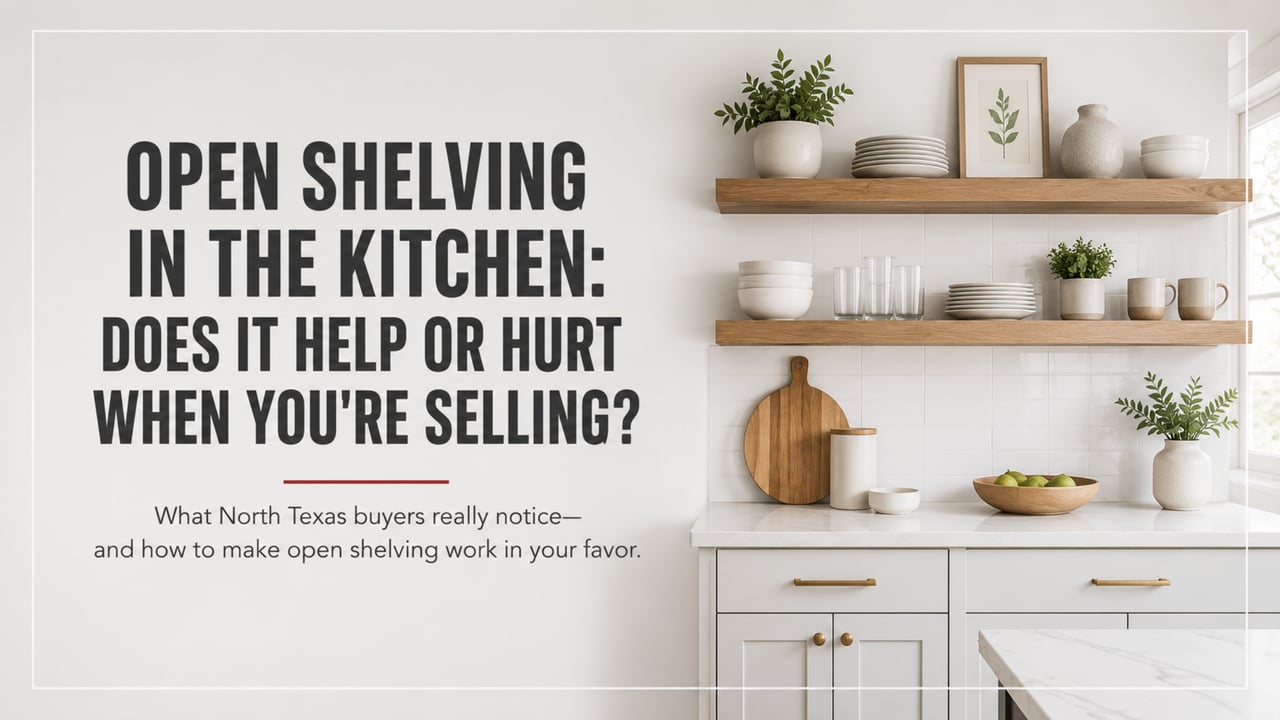
A well-styled set of shelves reads as intentional and confident. It signals that the kitchen was designed, not just assembled. If your shelves hold matching white dishes, a few plants, some neutral-toned cookware and nothing else, that photographs beautifully. Buyers who love that look will walk in already sold.
Newer builds and modern kitchens in particular can pull this off. If your home has a clean, contemporary design with consistent finishes, open shelving can feel like a natural extension of that aesthetic rather than a DIY add-on.
Open shelving also creates a sense of height and openness in the right space. When it's sparse and intentional, it doesn't close the kitchen down.
The Case Against
Here's where honesty matters more than encouragement.
Most sellers' open shelves are not camera-ready. They're full of everyday life: mismatched glasses, a box of cereal someone left out, vitamins, the mug with a chip you keep meaning to toss, a stack of plates in three different patterns. That's not a styled kitchen. That's storage displayed in public.
When buyers see that, two things happen immediately. First, the kitchen feels smaller and more chaotic than it actually is. Second, buyers start doing mental math: "Would I have to replace all of this? Restyle it? Put doors back on? How much would that cost?" You've just added a line item to their mental renovation budget before they've even opened the refrigerator.
This is especially common in North Texas homes built in the 1990s and early 2000s, where open shelves were sometimes added later as a trend rather than built into the original design. Those shelves often look exactly like what they are: cabinet doors that got removed and never went back. That's a hard look to style your way out of.
According to NAR research on home staging, kitchens consistently rank among the rooms that most influence buyer decisions. The details buyers notice in a kitchen, including what's on the shelves, carry real weight.
The 10-Foot Test
Before you do anything, run this test.
Stand 10 feet back from your open shelves. Just look. Where does your eye go first?
If you notice the space, the light, the clean lines of what's displayed, that's a good sign. If your eye goes straight to the stuff, you have a problem worth solving before you list.
This is the same way listing photos work. A camera is honest. It doesn't edit out the clutter or romanticize the chaos. If the shelves look busy from 10 feet away in person, they'll look twice as busy in a wide-angle listing photo.
What to Do if You Have Open Shelving
You have options and none of them require tearing anything out.
Edit ruthlessly. Take everything off the shelves. Put it in a box. Now only put back what you would see in a magazine photo. Matching items only. Consistent colors (white, natural wood, black). No food packaging, no random appliances, no personal items.
Keep it minimal. Three to five items per shelf maximum. Negative space is not your enemy. Buyers need room to imagine their own things there and a crowded shelf makes that impossible.
Go monochromatic. All white dishes, all natural wood tones, all neutral ceramics. Mixing patterns and colors is the fastest way to make a shelf feel chaotic.
Consider temporary closures. If you truly cannot get the shelves to a place that photographs well, you can temporarily close them off with cabinet-grade contact paper in a color that matches your existing cabinets. It's not a permanent solution, but it can get you through the listing period looking pulled-together rather than cluttered. The Spruce has a helpful guide on applying contact paper to shelves if you want a starting point.
What Not to Do
Do not take the shelves down and leave raw drywall holes. This looks significantly worse than cluttered shelves. Exposed drywall anchors, mismatched paint patches and bare wall sections immediately read as incomplete and deferred maintenance. If you're going to remove the shelves, you need to be prepared to patch, sand, prime and repaint the entire wall section, and match the existing cabinet color or finish.
That's a real project. If you're not ready to do it right, leave the shelves up and style them instead.
Jeanie's Take
Open shelving is a gamble and I'll be straightforward about that.
When it works, it's one of the best features in the kitchen. Buyers respond to it, it photographs well and it makes the space feel considered. When it doesn't work, it's often the first thing I hear in showing feedback. Buyers will say "the kitchen felt cluttered" and what they're describing is shelves loaded with mismatched everyday items they couldn't see past.
I've worked with sellers in Sachse and Lavon who had open shelves that were a genuine asset. I've also worked with sellers who needed to hear, kindly but clearly, that their shelves were costing them buyers. Knowing the difference matters.
If you're not sure which category you're in, that's worth a conversation before you list. A second set of eyes from someone who has watched buyers react to hundreds of kitchens across North Texas is worth more than a guess.
FAQ
Should I add open shelving before selling my home? No. Adding open shelving specifically to sell is rarely worth the investment or the risk. If your kitchen already has closed cabinets and is in good condition, leave it alone. Open shelving appeals to a specific buyer and requires near-perfect styling to photograph well. It's not a guaranteed value-add.
Can I paint open shelves to make them look better for a listing? Painting shelves a fresh, consistent color can help if the existing finish is dated, scuffed or mismatched. A clean white or a color that matches your cabinets can pull the look together. The styling still matters though. Fresh paint on a cluttered shelf is still a cluttered shelf.
How does open shelving affect home value in North Texas? Open shelving itself doesn't add or subtract a set dollar amount from your home's value in markets like Sachse, Wylie or Murphy. What it affects is buyer perception and how quickly your home sells. Shelves that make buyers hesitate or question the kitchen can extend your days on market, which creates its own set of problems. Redfin's data on seller preparation consistently shows that kitchen presentation is a top driver of buyer confidence.
Thinking about listing your home in Sachse, Wylie, Murphy, Lavon or Royse City and not sure if your kitchen is showing-ready? Jeanie Marten Real Estate does pre-listing walkthroughs to help you see your home the way buyers will. The goal is always to put your best foot forward without over-investing in changes that won't move the needle.