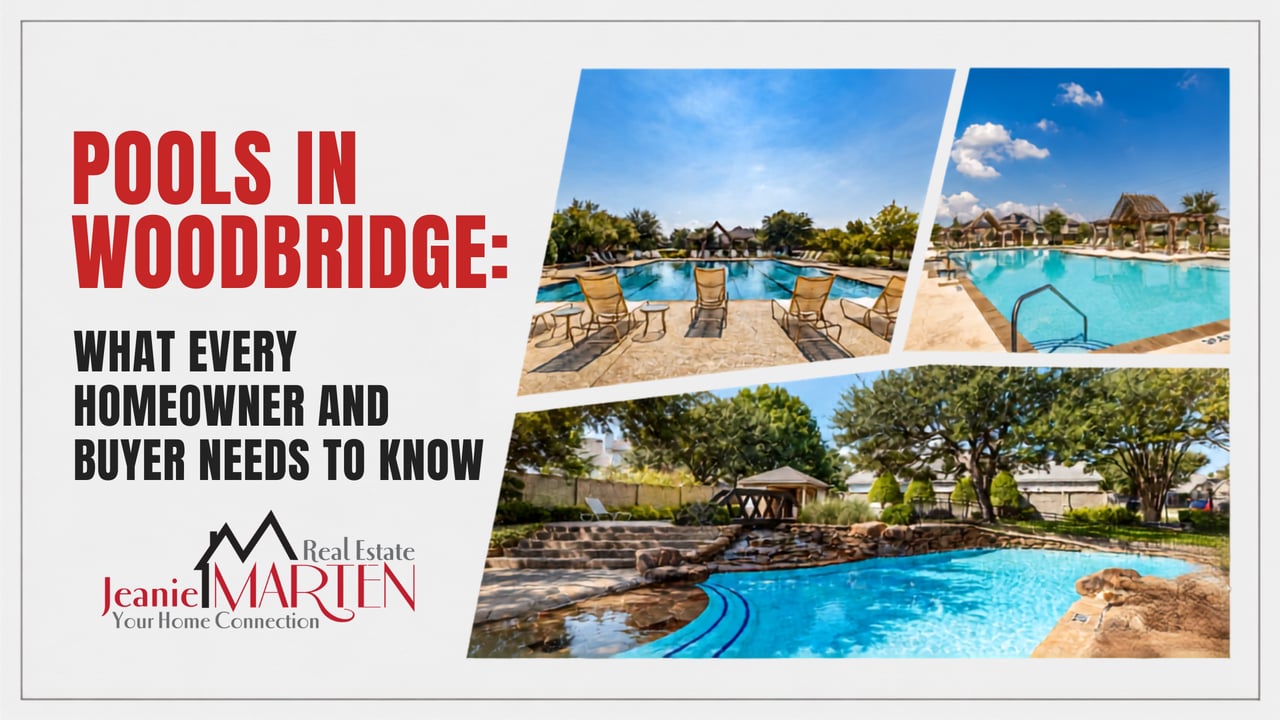
Pools in Woodbridge: What Every Homeowner and Buyer Needs to Know
There is something undeniably appealing about a backyard pool in a North Texas summer. The temperature climbs past 100°F for weeks at a time, the neighborhood kids are out of school and the idea of stepping through your back door into cool, blue water feels less like a luxury and more like a survival strategy. In Woodbridge, one of the most sought-after master-planned communities spanning Sachse and Wylie, pools are a beloved feature of neighborhood life and they show up frequently in the homes my clients buy and sell.
But a pool is not just a lifestyle amenity. It is a significant financial asset, a source of ongoing operating cost and, in North Texas specifically, a structure that demands a level of care that many buyers don't fully understand until they are already in the home. This post is meant to be the guide I wish every pool-owning client had read before they closed. We are going to cover pool values, seasonality, what it costs to build one today, what it costs to maintain one year over year, how long the equipment lasts and two issues that are almost uniquely North Texan: deck movement and the very real danger of leaving your pool empty.
The Seasonal Life of a Pool in Woodbridge
North Texas pools live on a compressed calendar. Unlike Florida or Arizona where a pool can be used ten or eleven months of the year, the DFW-area swim season typically runs from late April through mid-October, roughly five and a half to six months. Outside of that window, the pool is largely ornamental. You are maintaining it, paying for it (and maybe heating it) but you are not really swimming in it.
This matters for two reasons: lifestyle and value.
From a lifestyle standpoint, it means your cost-per-use calculation is different here than it would be in a warmer climate. A family that swims three or four times a week from May through September is getting excellent value from their pool. A couple whose kids have grown and who entertain infrequently may find the same pool is primarily a maintenance obligation for seven months out of the year.
From a value standpoint, the seasonality of pools in North Texas creates something genuinely interesting in the real estate market: the time of year you sell your home affects how much your pool is worth to a buyer. We will quantify that precisely in the next section.
It is worth noting that Woodbridge pools do need to be winterized each fall, not with antifreeze the way you might in a colder climate, but with a proper closing process that includes balancing the chemistry, lowering the water level, blowing out the lines and covering the pool. A pool left unattended through a North Texas winter freeze event, as we experienced dramatically in February 2021, can suffer cracked plumbing, damaged pumps and shattered equipment at a repair cost that easily runs $5,000 to $20,000 or more. Proper winterization, typically costing $150 to $300, is not optional.
What Is a Pool Actually Worth in Woodbridge? Real MLS Data.
This is the question every buyer and seller eventually asks and the honest answer is: it depends on when you're asking. I pulled every closed residential sale in the Woodbridge subdivision (Sachse and Wylie) over the past two years, from June 15, 2024 through June 15, 2026 and separated the results by pool ownership and season. Here is what the data shows.
The Overall Pool Premium
Across the full two-year dataset, pool homes in Woodbridge sold for approximately $8 to $12 more per square foot than comparable non-pool homes. On a median-sized Woodbridge home of around 3,000 square feet, that translates to a pool premium of roughly $24,000 to $36,000 at the time of sale. That is real money and it is a meaningful return on an amenity that costs $80,000 to $120,000 or more to install today.
That said, the premium is not as large as many sellers expect. A pool rarely adds dollar-for-dollar value against its construction cost in resale, particularly on newer builds. What it does do is make your home more marketable, reduces days on market in the right season and adds to your quality of life in the years before you sell.
Seasonality Is Real and the Numbers Prove It
When I broke the pool data out by season, the results were striking.
Summer pool sales (June through August, 10 closed sales): Pool homes averaged approximately $194 per square foot, about $10 per square foot more than non-pool homes sold in the same window (approximately $184 per square foot). On a 3,000 square foot home, that is a $30,000 premium that pool sellers captured specifically because of their pool.
Winter pool sales (December through February, 6 closed sales): Pool homes averaged approximately $178 to $184 per square foot, roughly the same as non-pool homes sold in the same period (approximately $183 per square foot). The pool premium in winter essentially disappears.
Let that sink in. The same pool, in the same neighborhood, is worth approximately $30,000 more in summer than it is in winter, based on when buyers perceive and value that feature. Non-pool homes, by comparison, showed almost no seasonal price variation at all (roughly $1 to $2 per square foot), confirming that this swing is specific to the pool feature and not just a general market seasonality.
What this means for sellers: If you have a pool and any flexibility in your listing timeline, spring and early summer is your window. Buyers who are actively shopping in June and July can see themselves using the pool immediately and they pay for that vision. Buyers shopping in January cannot, and the data shows they discount it accordingly.
What this means for buyers: If you want to negotiate the pool's value down, winter is your season. The market is telling you that sellers of pool homes are not capturing their seasonal premium in December through February.
What Does It Cost to Build a Pool in North Texas Today?
If you are considering adding a pool to your Woodbridge home, here is a realistic picture of what you should expect to budget.
Entry-level gunite pools (basic shapes, standard finishes): $75,000 to $95,000. This gets you a simple rectangular or freeform pool in the 400 to 500 square foot range with a basic plaster finish, standard LED lighting, a single-speed pump and a basic filter system. It does not include an attached spa, water features or extensive decking.
Mid-range pools with elevated finishes: $95,000 to $140,000. This is the sweet spot for most Woodbridge builds. You are looking at a larger or more intricate shape, a pebble or quartz aggregate finish (which lasts significantly longer than plaster), variable-speed pump, salt water system conversion, LED color-changing lighting, basic water features and 300 to 500 square feet of concrete or travertine decking.
Premium pools with spas, water features and outdoor living: $140,000 to $250,000 or more. Once you add an attached spa, a raised bond beam, a tanning ledge, multiple water features, an outdoor kitchen and high-end hardscape, costs escalate quickly. The "pool and outdoor living project" category is where most higher-end Woodbridge homeowners end up when they do it right.
Permitting and site work: Always budget $3,000 to $8,000 for permits, utility locates and site preparation, especially if your yard has drainage challenges or limited equipment access.
One important note for Woodbridge buyers and homeowners: HOA approval is required before breaking ground. The Woodbridge HOA has an architectural review process and pool designs must be submitted and approved before any work begins. Factor four to eight weeks into your timeline for this step and make sure your contractor is aware of the requirement.
Annual Pool Maintenance Costs: What to Budget
This is where many new pool owners get an unpleasant surprise. The pool is built, the water is in and then the monthly bills arrive. Here is a realistic breakdown of what it costs to operate a pool in the North Texas climate.
Weekly chemical service: If you hire a pool service company, which most Woodbridge pool owners do, expect to pay $120 to $175 per month for weekly visits that include testing and balancing chemistry, adding chemicals, skimming the surface and brushing the walls. Some services include filter cleaning; others charge extra. This is not optional maintenance. Improperly balanced water leads to algae, staining, plaster damage and equipment corrosion that will cost you far more than the service fee.
Electricity: A pool pump running on a traditional single-speed motor can add $75 to $150 per month to your electric bill during the active season. Variable-speed pumps, which have become the standard for new builds and are an excellent upgrade for existing pools, run dramatically more efficiently and can reduce this cost to $25 to $50 per month. If you are buying a home with an older single-speed pump, factor in a $1,200 to $1,800 upgrade to variable speed; it typically pays for itself within two to three years.
Chemicals for a salt water system: If your pool has a salt chlorine generator (which most newer Woodbridge pools do), your ongoing chemical costs are lower than a traditional chlorine pool. Budget $300 to $600 per year for salt replenishment, pH adjusters and algaecide as needed. Traditional chlorine pools typically run $600 to $1,200 per year in chemical costs for a homeowner managing their own chemistry.
Annual service items: Every year, you should budget for filter cleaning ($75 to $150), pool opening in spring ($150 to $250) and pool closing in fall ($150 to $300). Many service companies offer bundled seasonal packages.
Repairs: Budget a contingency of $500 to $1,500 per year for minor repairs such as a broken valve, a worn pool cleaner, a malfunctioning timer or a cracked return line fitting. These are the normal costs of owning mechanical equipment that runs year-round in a harsh climate.
Total realistic annual operating cost: For a typical Woodbridge pool with professional weekly service, a variable-speed pump and a salt system, budget $2,500 to $4,500 per year in normal operating costs, excluding major equipment replacements.
How Long Does Pool Equipment Last?
Understanding equipment lifespans helps you budget for capital replacements and avoid being blindsided when you are buying or selling a home with a pool. A good pool inspection, which I strongly recommend for any purchase involving a pool, should assess the age and condition of all major components.
Pool pump: A quality variable-speed pump should last 8 to 12 years with proper maintenance. Single-speed pumps often run to the same timeline but are less efficient. Replacement cost: $1,200 to $2,500 installed.
Filter: Sand filters typically need media replacement every 5 to 7 years ($200 to $400) and the tank itself can last 15 to 20 years. Cartridge filters need cartridge replacement every 1 to 3 years ($150 to $350 for cartridges) and the housing lasts 10 to 15 years. DE (diatomaceous earth) filters are less common but are serviced annually.
Salt chlorine generator (salt cell): The cell itself, the component that converts salt to chlorine, typically lasts 3 to 7 years depending on water chemistry management and usage. Replacement cell cost: $600 to $1,200. This is one of the most commonly overlooked expenses for new salt system owners.
Pool heater or heat pump: A gas heater generally lasts 7 to 12 years. A heat pump (more efficient for North Texas) lasts 10 to 15 years. Replacement cost: $2,500 to $5,500 installed, depending on type.
Automation system: Most modern pools have a digital automation controller (Pentair, Hayward or Jandy are the common brands in this market). These systems last 10 to 15 years but their interface boards and wireless remotes can fail earlier. Budgeting $800 to $2,500 for eventual automation system repairs or replacement is reasonable.
Interior finish (plaster, pebble or quartz): This is the largest periodic capital cost most pool owners face. Standard white plaster lasts 7 to 10 years before it begins to chalk, stain and roughen. Pebble and quartz aggregate finishes last 15 to 20-plus years. Replastering a typical pool: $7,000 to $14,000. Pebble or quartz re-finish: $12,000 to $22,000.
Waterline tile: The tile band at the water line is primarily cosmetic but also protects the shell at the critical evaporation zone. It typically lasts 15 to 25 years, but North Texas hard water and freeze-thaw cycles can accelerate deterioration. Budget $2,000 to $6,000 for eventual tile replacement.
When evaluating a pool at purchase, ask the seller for documentation on equipment ages and when the pool was last resurfaced. A home with an 18-year-old pool on original plaster with original equipment is a home that likely needs $15,000 to $30,000 in deferred capital investment in the near term.
The North Texas Deck Problem: What Expansive Soils Do to Your Pool Surround
This is the topic that surprises almost every buyer moving to North Texas from another state and it is one of the most important maintenance conversations you will have as a Woodbridge pool owner.
North Texas sits on some of the most expansive clay soil in the country. The particular blend of montmorillonite clay beneath the soil profile, including the soils under most of Woodbridge, shrinks dramatically when dry and expands dramatically when wet. During a prolonged drought (which we experience regularly), the soil under and around your pool deck can lose significant moisture and contract. When rain returns, it expands again. This cycle of expansion and contraction exerts enormous pressure on any structure resting on or in the soil, including your pool deck, your coping and the pool shell itself.
What you will see over time is this: your pool deck develops cracks, the coping separates from the pool edge, deck sections heave or settle unevenly and in severe cases the bond beam (the structural top edge of the pool) begins to crack. A deck that looks pristine on a first-time walk-through in spring may look significantly different after a summer drought followed by fall rains.
What to watch for and maintain:
The most important proactive step is keeping your soil moisture consistent. Many experienced North Texas pool owners run a soaker hose around the perimeter of the pool deck during extended dry periods, the same practice recommended for protecting home foundations. Keeping the soil from experiencing extreme wet-to-dry cycles significantly reduces movement damage.
Any crack in your pool deck wider than about 1/8 inch should be sealed promptly. Water that infiltrates a deck crack and reaches the expansive soil below creates a localized wet spot, which creates a localized expansion event, which widens the crack further. It is a self-accelerating problem if ignored.
Coping joints, the flexible sealant between your coping stones and the pool shell, are designed to move with soil expansion and contraction. This sealant needs to be inspected annually and replaced on average every 3 to 7 years. A compromised coping joint is a water infiltration point and water near the pool shell is one of the primary drivers of long-term structural damage. Replacement cost is typically $800 to $2,500 for a full coping re-seal, depending on pool perimeter.
Deck resurfacing is an eventual capital cost every North Texas pool owner should plan for. Concrete decks typically need resurfacing or coating every 8 to 15 years, depending on soil movement severity and maintenance. A re-cool-deck or re-coating runs $3,000 to $8,000 for a typical deck. A full concrete removal and replacement can run $12,000 to $25,000 or more if the movement has been severe.
Travertine and natural stone decks, while beautiful, require additional attention: grout lines need periodic re-pointing and individual pavers that have heaved need to be releveled. The trade-off is that travertine's modular nature actually handles soil movement better in some ways than monolithic poured concrete. A cracked paver can be replaced; a cracked slab requires grinding or demolition.
The Floating Pool: North Texas's Most Expensive Pool Mistake
If you take nothing else from this post, take this: never leave your pool empty in North Texas. Not for a week. Not for a winter.
Here is the mechanics of why. A swimming pool shell, whether gunite, shotcrete or fiberglass, is a large hollow structure sitting in the ground. When the pool is full of water, the weight of that water (roughly 18,000 to 25,000 or more gallons for a typical Woodbridge pool, or 150,000 to 200,000-plus pounds) holds the shell down in the ground. When the pool is drained, that weight is gone.
North Texas expansive clay soils retain groundwater. During and after rainfall or when the water table rises seasonally, hydrostatic pressure builds under and around the empty pool shell. Without the weight of the water to counteract it, that pressure can literally push the entire pool structure upward out of the ground, sometimes several inches, sometimes partially and in catastrophic cases nearly completely. This is what pool professionals call "floating" or "popping."
A floated pool is a construction catastrophe. The shell cracks, the plumbing is sheared, the electrical conduit is severed and the decking is destroyed. Repair, if the shell is even salvageable, typically runs $20,000 to $50,000 or more. In many cases, the pool must be demolished and rebuilt entirely.
When does this risk apply in Woodbridge? Any time the pool is fully drained. This includes:
- During replastering or resurfacing (the most common scenario, as a pool typically has to be drained completely for a refinish)
- During major repairs to the shell
- During a prolonged period when a home is vacant and pool maintenance lapses
- If a pool cleaner or service tech drains the pool to address an algae problem without understanding the risk
What responsible pool contractors do: When draining a Woodbridge pool for replastering or repairs, an experienced local contractor will drain as quickly as possible and refill as quickly as possible, limiting the empty time to as few days as practical, ideally 24 to 72 hours. They will also assess the soil conditions and time of year before proceeding; draining during or immediately after significant rainfall is a higher-risk window.
Some contractors install a hydrostatic relief valve in the main drain of the pool. This valve opens under hydrostatic pressure to allow groundwater to enter the pool shell rather than push it, relieving the pressure without floating the shell. If your pool does not have one, it is a worthwhile addition, particularly if you are planning any future replastering work.
If you are buying a home with a pool and the pool is empty (or the listing mentions it was recently replastered), get a structural inspection of the shell before closing. A qualified pool inspector can assess for floating damage, shell cracks and plumbing integrity.
The Full Financial Picture: Pool Ownership in Woodbridge at a Glance
Category | Estimated Cost |
|---|---|
New pool construction (mid-range) | $95,000 to $140,000 |
Annual operating costs (service, utilities and chemicals) | $2,500 to $4,500/yr |
Resurfacing (every 15 to 20 yrs for pebble/quartz) | $12,000 to $22,000 |
Equipment replacement (pump, salt cell and heater over 15 yrs) | $5,000 to $10,000 |
Deck maintenance and resurfacing | $3,000 to $25,000 (varies widely) |
Resale value premium (Woodbridge, summer sale) | +$25,000 to $35,000 |
Resale value premium (Woodbridge, winter sale) | approximately $0 to $6,000 |
So Should You Build, or Buy, a Pool in Woodbridge?
For the right family, absolutely. Woodbridge is a community built around outdoor living and a well-maintained pool extends your backyard season, enhances your quality of life and adds real resale value when you list at the right time of year. The community pool and amenities are excellent, but there is something different about having your own.
Go into it with eyes open. Understand that the operating costs are real and ongoing. Understand that North Texas soils require a level of deck and structural vigilance that pools in other climates do not demand. And understand that an empty pool in Woodbridge clay is a genuine structural risk, not a theoretical one.
If you are buying a home with an existing pool, always invest in a dedicated pool inspection in addition to your standard home inspection. A thorough pool inspector will evaluate the shell, the equipment ages and condition, the plumbing, the electrical and the deck. The cost is $200 to $400 and it can save you from a $20,000 surprise.
If you have questions about pool homes in Woodbridge, want to understand how a pool factors into the value of a home you are considering or are ready to talk about listing your pool home at the right time of year to maximize your return, I am happy to have that conversation.
Jeanie Marten | Jeanie Marten Real Estate Specializing in Woodbridge, Sachse and Wylie Market data sourced from NTREIS/MLS, closed sales 06/15/2024 to 06/15/2026