
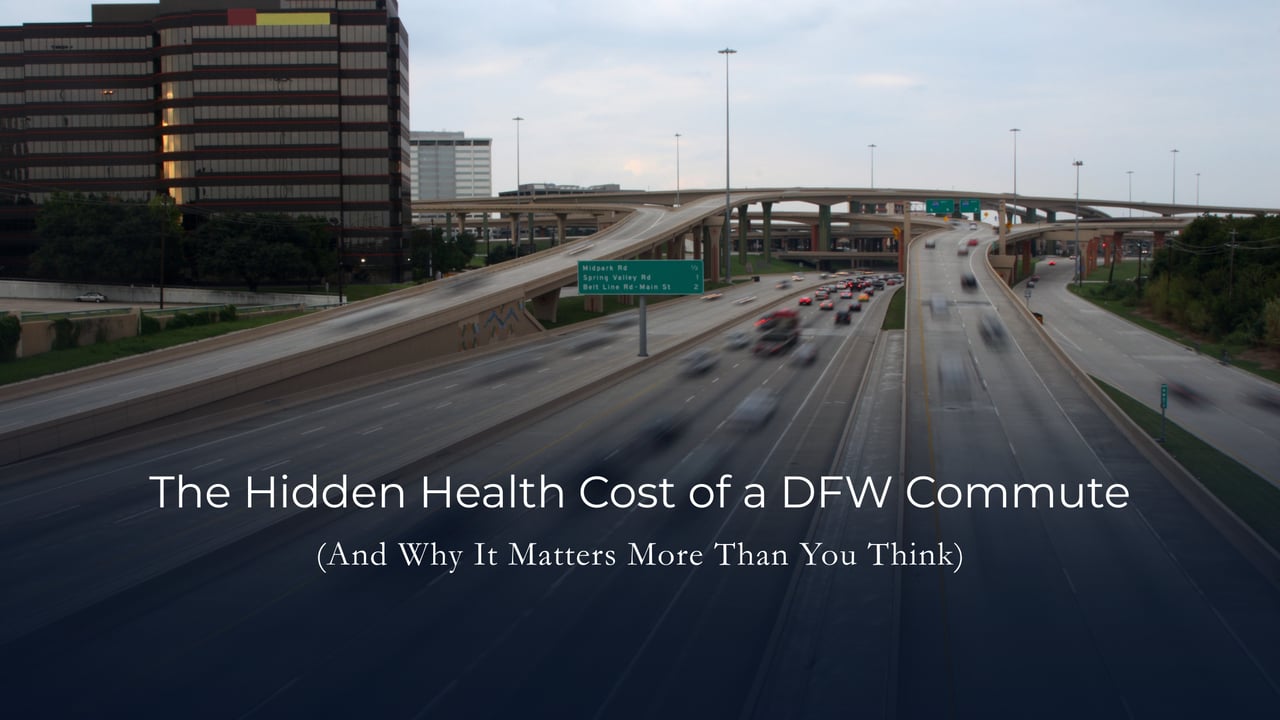
How far should you be willing to drive every day for a “better deal” on a home?
On paper, a longer commute often looks like a reasonable tradeoff in Dallas–Fort Worth: more house, newer construction, lower price per square foot. But when you zoom out, commute time isn’t just a convenience issue—it’s a health, lifestyle, and long-term financial decision that quietly shapes how happy you’ll be in your home.
Here’s how that plays out specifically across DFW.
Why Commute Time Hits Harder in DFW Than Buyers Expect
DFW is built around cars. Even buyers who plan carefully often underestimate how distance + congestion + car dependency compound over time.
In real terms:
-
A “30-minute commute” from Plano, Frisco, or Mansfield can easily become 45–60 minutes during peak hours.
-
Highways like US-75, I-35E, and I-635 are unpredictable, meaning commute variability becomes as stressful as commute length.
-
Toll roads reduce drive time—but increase out-of-pocket costs that rarely get factored into a housing budget.
Research consistently shows that longer, car-based commutes are associated with:
-
Higher stress and burnout
-
Shorter and poorer-quality sleep
-
Increased blood pressure, BMI, and cardiometabolic risk
Those effects intensify when traffic congestion is part of the equation—which, in DFW, it usually is.
The Real Estate Reality: You’re Already Paying for Commute Time
Whether buyers realize it or not, housing prices in DFW reflect access to jobs.
Homes closer to major employment hubs like Dallas, Irving, Plano, and Fort Worth tend to cost more because:
-
Shorter commutes preserve time and energy
-
Predictability matters as much as distance
-
Buyers value flexibility if jobs or schedules change
This is known in housing economics as the “price of access to employment.” You either pay more upfront—or you pay later through time, stress, and long-term wear and tear.
The Hidden Costs of “Cheaper Homes Farther Out”
That lower purchase price in outer suburbs or exurban areas often ignores costs that don’t show up on a mortgage statement:
-
Time loss: 5–10 extra hours per week in traffic adds up fast.
-
Vehicle costs: Fuel, tolls, maintenance, and depreciation rise sharply with distance.
-
Health tradeoffs: Chronic stress and sleep disruption have real downstream effects.
-
Resale sensitivity: Homes with long, unpredictable commutes are more price-sensitive in shifting markets.
This is why buyers in farther-out areas often experience:
-
Higher turnover
-
More hesitation during market slowdowns
-
Greater resistance to tax and insurance increases
If You Can’t Shorten the Commute, Improve the Commute
Not everyone can live close to work—and that’s okay. The key is improving commute quality, not just minimizing distance.
In DFW, that might mean:
-
Choosing areas with multiple route options instead of a single highway dependency
-
Living near DART rail lines to mix driving and transit
-
Prioritizing neighborhoods where daily errands don’t require long drives
-
Reducing congestion volatility, even if total miles stay the same
Small changes in predictability and routine can significantly reduce stress—even when commute time doesn’t change much.
The Takeaway for DFW Buyers and Sellers
Commute time isn’t just about convenience—it’s a health and lifestyle cost that quietly affects:
-
Home values
-
Daily well-being
-
Long-term satisfaction
-
Resale performance
When you evaluate homes in DFW, the smartest question isn’t “How much house can I get?”
It’s “How will this location affect my life five years from now?”
Want Help Evaluating Commute Tradeoffs Before You Buy or Sell?
If you’re weighing price, location, and long-term livability in DFW, I can help you think through those tradeoffs strategically—before they become expensive surprises.
Reach out to talk through your commute, your priorities, and which areas actually support the lifestyle you want.