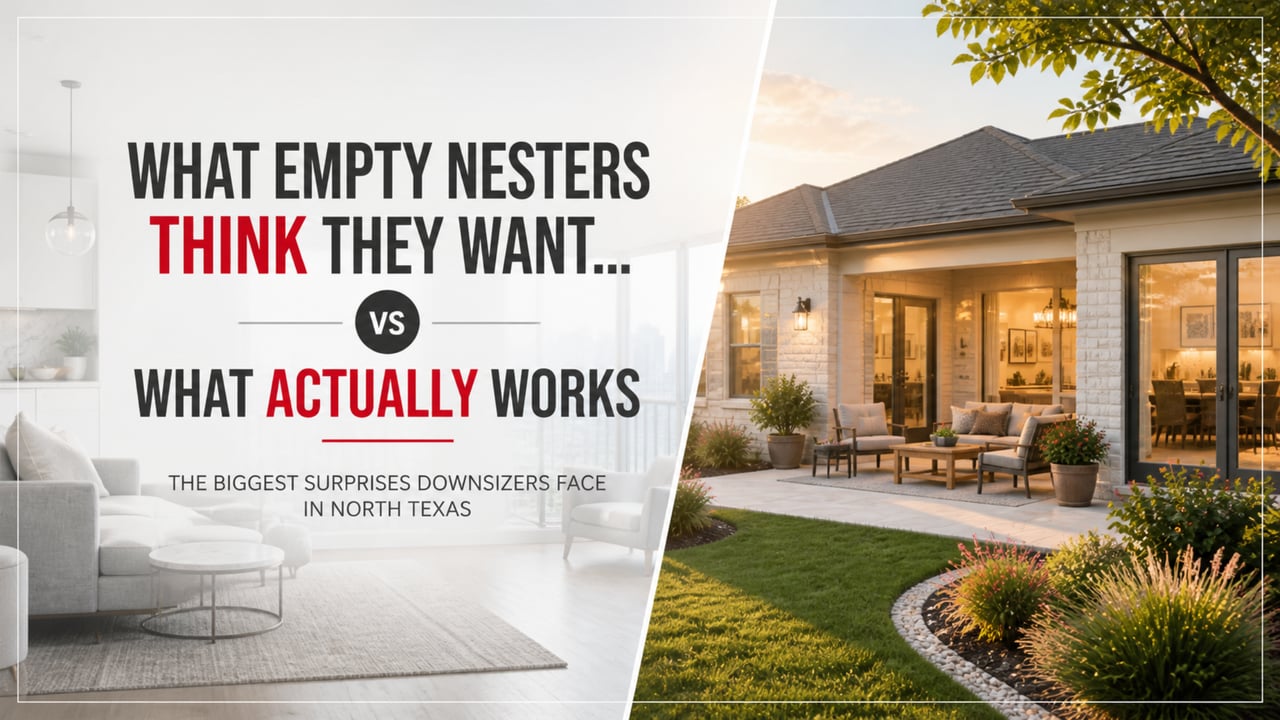
What Empty Nesters Really Need in Their Next Home — and What Surprises Them Most
What should empty nesters look for in their next home? Empty nesters need single-story layouts, flexible guest space, low-maintenance exteriors and quality finishes over square footage and the financial equity to make a strong move.
The house that worked perfectly for a family of four or five feels different once the last kid moves out. The rooms don't get used. The yard maintenance is still there every weekend. And you're left asking a question that sounds simple but isn't: what do I actually want now?
This is one of the most significant and underestimated real estate transitions you'll ever make. It's not just about square footage. It's about figuring out what this next chapter of your life looks like and then finding a home that fits it. In communities like Sachse, Wylie, Murphy and Lavon, there are genuinely great options for buyers in this season but getting there requires honesty about what you think you want versus what you'll actually need.
Here's what I see most often when I work with empty nesters and downsizers in North Texas and I am personally face to face with this transition.
What Empty Nesters Need in Their Next North Texas Home
"I want something smaller and simpler."
You probably do want smaller. But "simpler" is where it gets complicated.
Most empty nesters come in convinced they want to cut square footage dramatically. Then they spend one holiday with the kids sleeping on an air mattress in the living room and the calculus changes fast.
You don't need four bedrooms. But you likely want two guest rooms one for overnight visits that actually feels like a real room, and one that can flex as an office or hobby space the rest of the year. The difference between a 1,600 sq ft home and a 2,100 sq ft home often comes down to exactly that: one extra room that makes the whole house work.
"I want a condo — no yard, no maintenance."
This is the fantasy and it's valid. But talk to people who've lived it for a year.
The maintenance-free lifestyle has real appeal after decades of mowing, irrigation systems and fence repairs. What surprises many people is how much they miss outdoor space once it's gone a place to have coffee in the morning, a small garden, somewhere for the dog to go. Zero-lot-line properties and condos solve one problem and create another.
A smaller yard with low-maintenance landscaping think native Texas plants that require little irrigation and a manageable footprint gives you the best of both. You still have outside space. You've just stopped spending your weekends fighting it.
"I want to be near my kids."
Proximity matters. It genuinely does. But "near the kids" sometimes becomes its own trap.
What empty nesters often discover is that they want to be close enough — 20 to 30 minutes, say — but they also want their own community, their own routines, their own neighbors. Planting yourself in the exact neighborhood your adult children live in can blur those lines in ways that don't always serve anyone well.
The better question is: where do you want your life to be centered? Start there and work outward.
What You Actually Need (And Often Don't Plan For)
Single-Story or Primary Bedroom on the Main Floor
This isn't about being pessimistic about getting older. It's about being smart.
A home that works for you at 58 should also work for you at 72. That means not having to climb stairs to get to your bedroom every night and not being dependent on a second story if mobility ever becomes an issue. Single-story homes are in high demand in North Texas for exactly this reason which means they also hold their value well.
If a two-story home is the right fit on every other dimension, at minimum make sure the primary suite is on the main floor.
A Dedicated Flex Room
Call it an office, a hobby room, a studio or a guest room with a desk the label doesn't matter. What matters is having a room that isn't just a bedroom.
Retirement looks different for everyone: part-time consulting, woodworking, painting, a serious reading habit, video calls with grandkids. A flex space that adapts to whatever this chapter holds is one of the most undervalued features in a downsizer's home.
A Yard That's Functional, Not Massive
If you love gardening, don't give it up entirely. A smaller yard with raised beds, good light and a patio is far more satisfying than a zero-lot-line property where your outdoor world is a balcony and a parking spot.
The goal isn't no yard. It's a yard you can actually enjoy without it running your weekends.
Lower-Maintenance Exterior Materials
Brick and Hardie board siding are your friends. Wood exteriors look great in photos and become a maintenance burden in the Texas heat within a few years. When you're evaluating homes, look at what the exterior is made of it's one of those things that quietly determines how much time and money you spend on upkeep.
Quality Over Square Footage
A 1,800 sq ft home with quartz counters, hardwood floors, a well-designed kitchen and good light will serve you better than a 2,800 sq ft home with dated finishes and rooms you never enter.
In North Texas communities like Wylie and Royse City, newer construction often offers better finishes at a smaller footprint and that's a trade worth seriously considering. Resale on quality holds up. Resale on size alone does not.
Walkability and Community
This one catches people off guard. When you no longer have kids' schedules structuring your social life, you have to build that yourself. Neighborhoods with walkable coffee shops, trail systems and a genuine sense of community help you do that.
Murphy and Sachse both have areas worth considering if this matters to you. It's worth asking your agent about walkability scores and nearby amenities not just lot size and HOA fees.
Storage
Downsizing sounds like it solves the storage problem. It rarely does on its own.
You're consolidating two or three decades of a family's worth of belongings into a smaller space. Built-in storage, a usable garage, a walk-in pantry and well-designed closets matter more than you'd expect. When you're touring homes, open the closets. They tell you a lot.
The Financial Picture
Many empty nesters are selling a home they've owned for 15 to 25 years, which means they're often sitting on significant equity. That is a powerful position. It can mean paying cash, putting down a large down payment or carrying a very small mortgage all of which change your options dramatically.
What surprises people: downsizing doesn't always mean spending less. A smaller home in a better location, newer construction, or a community with strong amenities can cost the same or more than the home you're leaving. You're not just trading square footage for dollars. You're trading one set of priorities for another.
Before you sell, talk to a CPA about the tax implications. The IRS home sale exclusion allows most homeowners to exclude significant gains from the sale of a primary residence but the rules have details that matter, especially if you've owned the home a long time or the equity is substantial. That's not a conversation to skip.
Frequently Asked Questions
Is it better to buy first or sell first when downsizing in North Texas? This depends on your financial cushion and local inventory. In areas like Sachse and Wylie where well-priced homes move quickly, many downsizers prefer to sell first and use the equity as leverage sometimes staying in temporary housing briefly to avoid a contingent offer. Your agent can help you map out the right sequence based on current conditions.
How much smaller should I go when downsizing? Most empty nesters find that going from 2,800–3,500 sq ft to 1,800–2,200 sq ft hits the right balance — meaningfully less to maintain, but enough room for guests and a flex space. Going smaller than 1,600 sq ft can feel limiting once you're actually living in it day to day.
What North Texas communities are good fits for empty nesters and downsizers? Sachse, Wylie, Murphy, Lavon and Royse City all have options worth exploring — each with a different character. Murphy and Sachse tend to have more established neighborhoods with mature trees and proximity to amenities. Royse City and Lavon have newer construction with modern layouts. The right fit depends on your priorities around location, price point and lifestyle. A local agent who knows all of these areas can help you compare them honestly.
Ready to Think Through Your Next Move?
This transition deserves more than a quick Zillow search. It deserves a real conversation about what you want this next chapter to look like and a strategy that gets you there without leaving equity on the table or ending up in a home that doesn't fit.
Reach out to Jeanie Marten Real Estate. We work with buyers and sellers across Sachse, Wylie, Murphy, Lavon, and Royse City, and we'll give you a straight answer about what's realistic, what to watch out for, and how to make a confident move.