
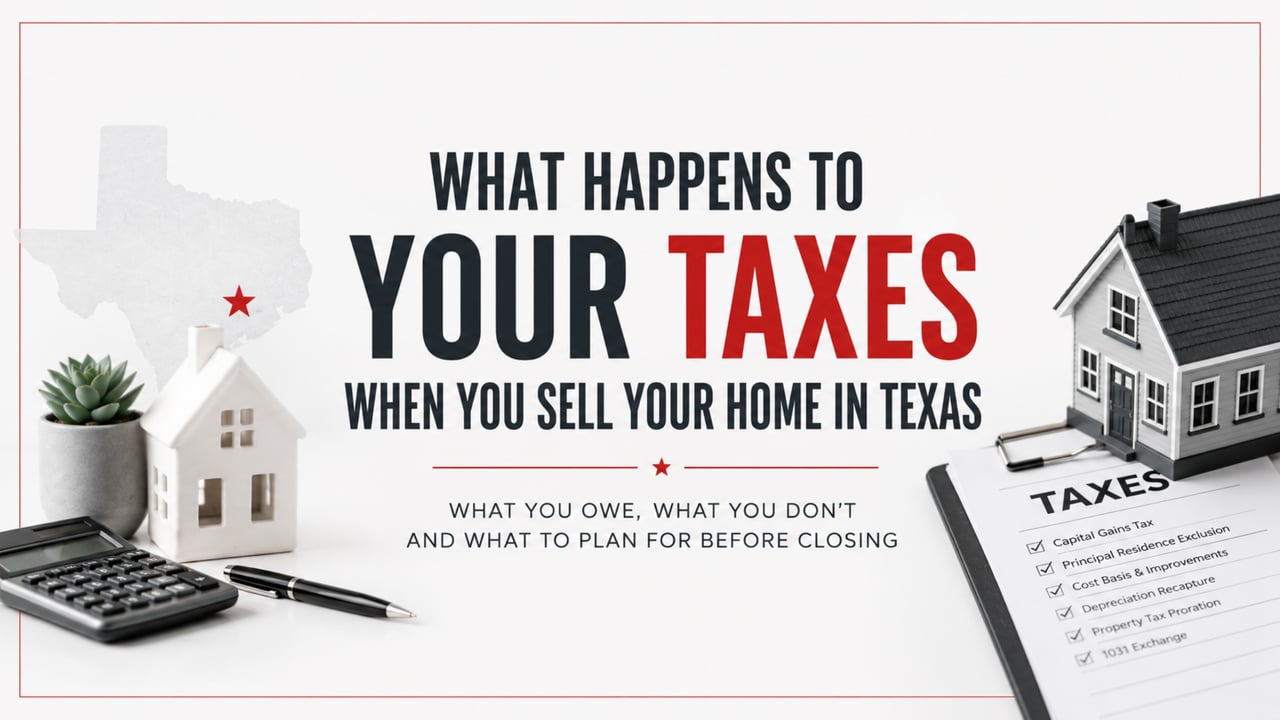
What taxes do you pay when you sell a home in Texas? Texas has no state income tax, so sellers avoid that layer entirely — but federal capital gains tax still applies. Whether you owe anything depends on how long you lived there, what you paid, and what improvements you made.
Selling a home is one of the biggest financial events most people go through. And yet the tax side of that transaction often gets very little attention until the closing table is close. If you're thinking about selling in Sachse, Wylie, Murphy, Lavon, or Royse City, understanding a few key rules now can save you real money — or at least real stress.
This post breaks down the main tax considerations for Texas home sellers in plain language. It is not tax advice, and every situation is different. You should always work with a qualified CPA before you sell. But knowing the basics puts you in a much better position to have that conversation.
Taxes When You Sell Your Home in Texas Explained
Let's start with the win. Texas is one of a handful of states with no state income tax. That means when you sell your home, Texas is not taking a cut of your gain. This is a genuine financial advantage that sellers in many other states don't have.
You still need to think about federal taxes, though. The IRS does not care which state you live in.
Federal Capital Gains Tax: The Basics
When you sell an asset for more than you paid for it, the profit is called a capital gain. For most home sellers, the relevant question is whether that gain is short-term or long-term.
- Short-term capital gains apply if you owned the home for less than one year. These are taxed at your ordinary income rate, which can be significantly higher.
- Long-term capital gains apply if you owned the home for more than one year. The rate is 0%, 15%, or 20%, depending on your taxable income.
Most homeowners who have lived in their home for several years will be dealing with long-term gains. The more important question is whether you qualify for an exclusion that wipes out — or reduces — what you owe.
The Primary Residence Exclusion (IRS Section 121)
This is the rule that protects most home sellers from owing any federal tax at all. Under IRS Section 121, you can exclude up to:
- $250,000 of gain if you file as single
- $500,000 of gain if you are married filing jointly
To qualify, you must have owned the home and used it as your primary residence for at least 2 of the last 5 years before the sale. The two years do not need to be consecutive.
So if you bought a home in Sachse for $300,000, made some improvements, and sold it for $520,000 — and you're married and have lived there for three years — your $220,000 gain falls well under the $500,000 exclusion. In that scenario, you likely owe no federal capital gains tax on the sale.
Understanding Your Cost Basis
Your taxable gain is not simply the sale price minus what you originally paid. It's the sale price minus your cost basis — and your basis can be higher than your purchase price.
Your cost basis generally includes:
- The original purchase price of the home
- Closing costs you paid when you bought it (certain ones, like title fees and legal fees)
- The cost of permanent improvements you made over the years — a new roof, an addition, a kitchen remodel, updated HVAC
Routine maintenance and repairs typically don't count. But significant capital improvements do. If you've kept receipts for major projects, now is the time to find them. A higher basis means a lower taxable gain.
If the Home Was Ever a Rental: Depreciation Recapture
This is a wrinkle that catches some sellers off guard. If you ever rented your home — even for a portion of the years you owned it — the IRS may require depreciation recapture.
When a property is used as a rental, owners can deduct depreciation on their taxes each year. When you sell, the IRS wants to recapture those deductions. That amount is taxed at a maximum rate of 25%, separate from the capital gains rate.
If your home in Wylie or Murphy was your primary residence the whole time you owned it, this likely doesn't apply to you. But if it was an investment property, or if you rented it out for a period, talk to a CPA before you assume your tax picture is simple.
When You Don't Qualify for the Full Exclusion
Not everyone meets the two-year residency requirement. Life happens — job relocations, divorces, health issues, or other circumstances sometimes force a sale before you hit that threshold.
The IRS does allow a partial exclusion in certain hardship situations. The amount you can exclude is prorated based on how long you lived in the home relative to the two-year requirement. For example, if you lived there for 12 of the required 24 months, you may be able to exclude 50% of the normal limit.
If you're selling before hitting the two-year mark, don't assume you're automatically on the hook for full taxes. Check with a CPA — you may qualify for at least some protection.
Property Taxes in Texas: Paid in Arrears
Here's something that surprises a lot of first-time sellers in Texas. Property taxes here are paid in arrears, meaning you pay this year's taxes at the end of the year (or early the following year). That creates a proration situation at closing.
When you sell your home, you'll owe a credit to the buyer for the portion of the year's taxes that have accrued on your watch — even though that bill hasn't come due yet. This is calculated at closing and reduces your net proceeds accordingly.
It's not a surprise expense if you know it's coming, but it's worth building into your estimates. Your title company handles the math, and your real estate agent can help you understand what to expect before you get to the table.
A Brief Note on 1031 Exchanges
If the property you're selling is an investment property — not your primary residence — you may have another option: a 1031 exchange. This IRS provision allows you to defer capital gains taxes by rolling the proceeds into a like-kind investment property within specific timeframes.
1031 exchanges have strict rules and deadlines. They don't apply to your primary residence. But if you own a rental property in Lavon or Royse City and you're thinking about selling, it's worth asking your CPA whether an exchange makes sense before you list.
When to Bring in a CPA
Real estate agents can walk you through what to expect at the closing table. But tax strategy is a CPA's territory, and you should involve one before you sell — not after.
This is especially true if:
- Your gain is close to or above the exclusion limit
- You owned the home for less than two years
- The property was ever used as a rental
- You've made significant improvements and need help calculating your basis
- You're considering a 1031 exchange
A good CPA can help you time the sale, document your basis correctly, and avoid surprises on your return.
Frequently Asked Questions
Do I pay Texas state income tax when I sell my home? No. Texas has no state income tax, so there is no state-level capital gains tax on the sale of your home. You only need to account for federal taxes.
What if I lived in my home for less than two years before selling? You may not qualify for the full primary residence exclusion, but you could still qualify for a partial exclusion if the sale was due to a qualifying hardship such as a job change, health issue, or other unforeseen circumstance. Talk to a CPA to find out what applies to your situation.
How does property tax proration work at closing in Texas? Because Texas property taxes are paid in arrears, you'll owe a credit to the buyer at closing for the portion of the current year's taxes that accrued while you owned the home. Your title company calculates this amount as part of the closing settlement.
Ready to Talk Through Your Sale?
Selling your home in Sachse, Wylie, Murphy, Lavon, or Royse City involves more moving parts than most people expect — and the financial side deserves real attention. At Jeanie Marten Real Estate, we help sellers understand the full picture before they list, so there are no surprises at the finish line.