
Have you ever noticed how some cities just feel better to live in?
Often, it’s not the homes themselves—it’s the space around them. And in Murphy, that space is doing more heavy lifting than most buyers realize.
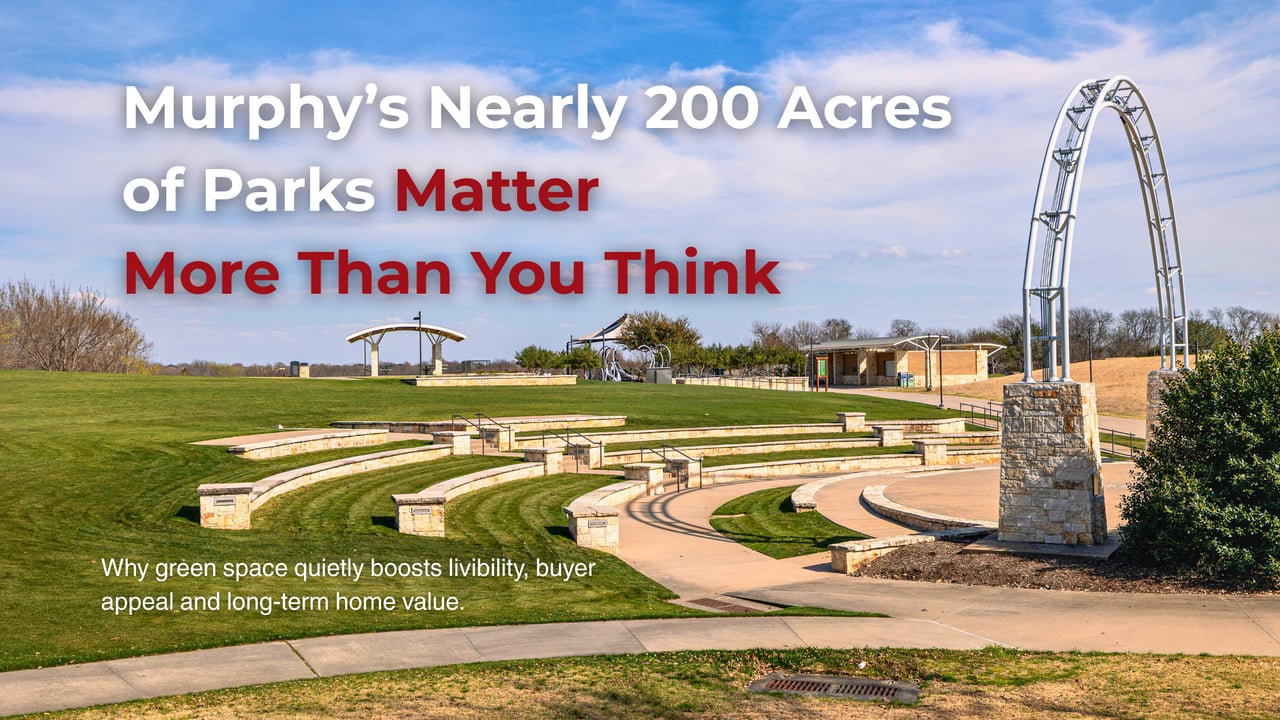
Murphy quietly offers something extraordinary for a city of roughly 21,000 residents: nearly 200 acres of public parkland across 10 parks, including a standout ~60-acre central park and connected trail systems. That’s not just a lifestyle perk—it’s a value driver.
Below is why Murphy’s park system is unusually generous, how it compares to other cities, and what research says that kind of green space can mean for property values.
Murphy’s Park Footprint Is Bigger Than It Looks
Murphy maintains ~195.5 acres of public parks, anchored by Murphy Central Park and supported by neighborhood parks and trail corridors. For a city of its size, that’s well above what many similarly sized suburban towns dedicate to public green space.
There’s no single nationwide “standard” for park acreage per resident—but comparisons help put this in context:
-
Many suburban cities of similar population operate with far smaller park systems
-
Even large metros can struggle to dedicate meaningful portions of land to parks
-
For example, Dallas, despite having hundreds of parks, devotes well under 20% of its land area to parks and trails across a vastly larger population
What makes Murphy stand out isn’t just the number of parks—it’s the scale and continuity. Large parks, connected trails, and usable green space matter more than scattered pocket parks when it comes to livability and long-term appeal.
Why Buyers Care About Green Space (Even If They Don’t Say It)
When buyers compare homes, they often focus on square footage, finishes, and price. But research consistently shows that access to green space quietly influences what buyers are willing to pay.
Here’s what studies across multiple markets have found:
1. The “Proximity Premium” Is Real
-
Homes within roughly ¼ mile of protected open space see an average ~3.6% value increase
-
Properties adjacent to or near parks and green spaces often sell for 8–20% more than similar homes without nearby parks
-
Broad reviews commonly land in the 8–10% premium range for proximity to passive parkland
In other words, walking distance matters—and Murphy offers that advantage across multiple neighborhoods.
2. Size and Continuity Increase Value
Not all parks impact value the same way.
-
Larger parks and long green corridors tend to generate stronger premiums
-
Connected trails and greenbelts outperform isolated, small parks
-
Some high-end estimates show homes near extensive greenbelts capturing significantly higher premiums than average
Murphy’s combination of a large central park and trail connections fits squarely into what buyers respond to most.
3. Distance Changes the Impact
The value effect isn’t unlimited—it’s strongest close by:
-
The biggest impact is typically within 100–200 meters (300–650 feet)
-
The premium tapers as distance increases
-
Short walks outperform short drives when it comes to buyer perception
That makes neighborhood layout and park distribution especially important—and Murphy benefits from having parks woven into the city rather than pushed to the edges.
4. What You See Matters, Too
It’s not just about a dot on a map.
Research shows that visible greenery—trees, park views, trail vistas—adds measurable value. A home with a green view often outperforms an otherwise identical home without one.
In practical terms:
-
A living room overlooking trees can be worth more than one facing rooftops
-
Streetscapes with mature landscaping feel more desirable—and buyers respond accordingly
Why This Translates Into Higher Property Values
Green space delivers real quality-of-life benefits—room to walk, exercise, gather, relax, and connect. Buyers may describe this as “feel,” “vibe,” or “livability,” but the market consistently prices it in.
Murphy’s nearly 200 acres of parks aren’t just a nice bonus. They represent:
-
Intentional land use
-
Long-term community investment
-
Scarce, non-replicable space
And scarcity is exactly what supports value over time.
The Big Takeaway
For a city of its size, Murphy’s park system is meaningfully generous, not average. Large parks, connected trails, and visible green space create daily benefits that buyers value—whether they consciously articulate it or not.
When you’re comparing homes or neighborhoods, park access isn’t just about recreation. It’s about desirability, resilience, and long-term value—and Murphy has quietly built a strong foundation on all three.
Thinking about buying or selling in Murphy?
Understanding how location features like parks influence value can help you make smarter decisions—and spot advantages others overlook. Reach out if you want help evaluating how proximity, views, and neighborhood layout factor into today’s market.