
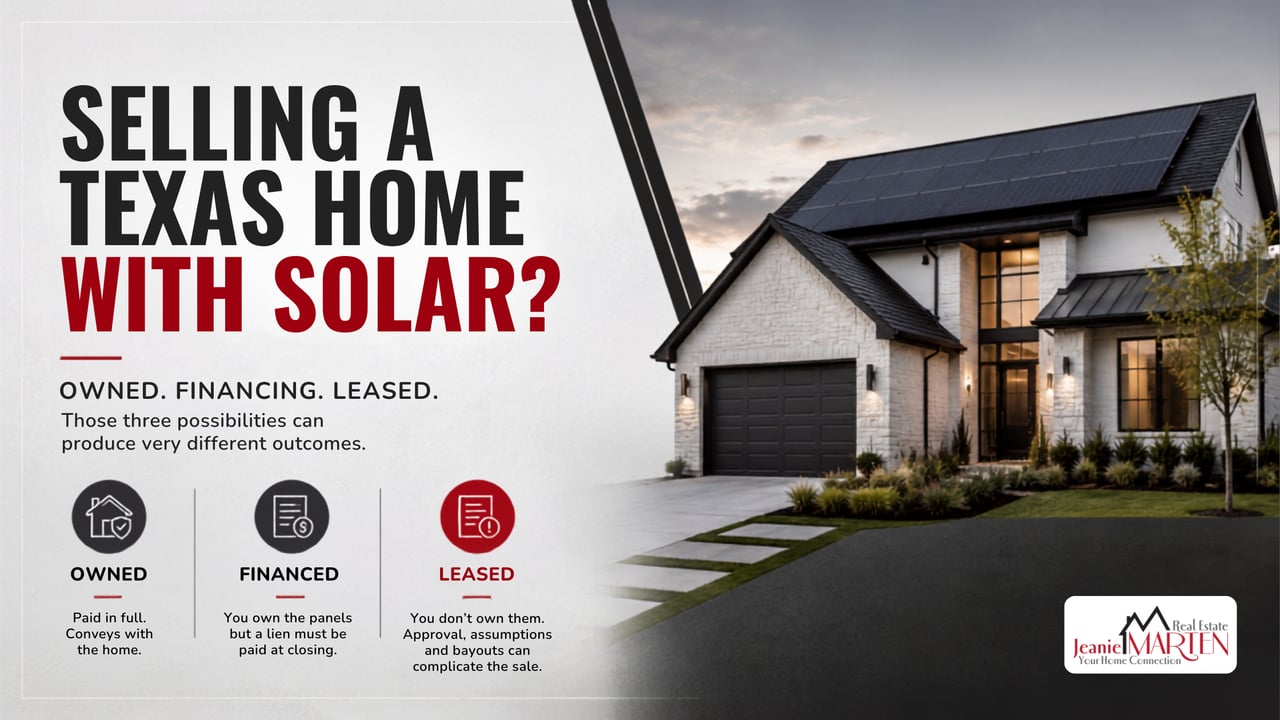
Do solar panels make a Texas home harder to sell? Owned panels usually do not. Leased and financed panels do, because of the lien on your title and the buyer credit approval the solar company controls. The contract matters more than the panels.
I posted a short video about solar companies and it clearly touched a nerve. So here is the part that would not fit in sixty seconds.
Let me be precise about what I object to because this gets muddled. I have no argument with solar as a technology. Panels work. Plenty of my clients are happy with theirs. What I object to is how a chunk of this industry sells and finances these systems and what that paperwork does to a transaction two years later when somebody wants to move.
I am not alone in that and I am not being dramatic. The State of Texas is now involved.
The Texas Attorney General is investigating this industry
On April 3, 2026, the Texas Attorney General's office launched an initiative targeting residential solar sales practices, issuing Civil Investigative Demands to Freedom Forever, Sunrun, Lone Star Solar Services and CAM Solar. The office cited more than 100 complaints filed directly with it and thousands more posted online.
The alleged conduct centers on misrepresentations about how much homeowners would save on their energy bills, how well the systems would actually perform and the companies' own terms and policies.
In May 2026, the state filed suit against CAM Solar, a San Antonio company, under the Texas Deceptive Trade Practices Act. The allegations include savings that never materialized, systems that did not function, improper installations, service requests that went unanswered, undisclosed warranty and maintenance fees and misrepresented eligibility for tax credits.
These are allegations, not findings and the companies are entitled to defend themselves. But when the state's top consumer protection office says thousands of Texans have been targeted, that is not a handful of unhappy customers. That is a pattern.
The three words that decide everything
When a listing has solar, my first question is never about the panels. It is about the contract. There are three possibilities and they behave completely differently.
Owned outright. You paid cash or you paid off the loan. The panels convey with the house like a water heater. This is the easy one and it is the only version that reliably shows up as value in an appraisal.
Financed with a solar loan. You own the panels but owe money on them and there is almost certainly a filing against your property. That balance gets paid off at closing out of your proceeds, the same as any other lien.
Leased or on a power purchase agreement. You do not own anything. You are renting equipment bolted to your roof, usually on a twenty to twenty-five year term, often with an escalator clause that raises your payment every single year. This is where deals die.
Most homeowners genuinely do not know which one they have. If you are not certain, go find the contract before you do anything else.
The filing that shows up on your title commitment
Solar companies protect their equipment by recording a UCC-1 fixture filing. It attaches to the solar equipment rather than to your house and the industry is quick to point out that distinction.
Here is why that distinction does not help you much. When your title company runs the commitment, that filing surfaces. Your buyer's lender sees it. And now somebody has to clear it, subordinate it or transfer it before anyone funds. That takes cooperation from a solar company with no interest whatsoever in your closing date.
I have watched this add weeks to transactions. Not because anyone did anything wrong, but because the third party holding the pen does not answer the phone.
Your buyer has to qualify and you do not control that
This is the part that catches sellers completely off guard.
If you have a lease or a PPA, your buyer cannot simply agree to take over the payment. The solar company runs its own credit check, on its own timeline, and decides whether to approve the assumption. A buyer who sailed through mortgage underwriting can still be turned down by the solar company.
If they will not qualify, or they will not accept the payment, your realistic options narrow to paying the thing off at closing. Buyout figures on older agreements are routinely far higher than sellers expect, and because of the escalator, the monthly payment your buyer would inherit is often meaningfully higher than what you are paying today.
Start this the day you list. Not during the option period. Assumption processing does not fit inside a Texas option period, and I have written before about how the option period is where North Texas deals are dying. Solar is one of the reasons.
The hail math nobody mentions at the kitchen table
We are in North Texas. Roofs here have a working lifespan measured in storms, not decades.
When your roof gets replaced, the panels come off and go back on. In the Dallas area that detach and reset runs roughly $1,500 to $5,000, with most residential jobs landing in the $2,000 to $3,500 range and it adds days to the schedule because the reinstall waits on the new roof.
Now layer on your insurance. Most North Texas policies carry a wind and hail deductible of two percent or more, which on a $500,000 home is a $10,000 deductible before anything gets paid. Some policies exclude the detach and reset labor specifically. Some insurers deny cosmetic panel damage if the panels still produce power.
Nobody mentions any of this during a twenty minute pitch on your porch. It is real money and in Sachse, Wylie, Murphy and Lavon it is not hypothetical.
If you have solar and you might sell
Do these five things now, not when you are under contract.
- Find the contract and determine whether you own, financed or leased. This single fact drives everything else.
- Call the solar company and get the transfer process and its timeline in writing.
- Request a current buyout or payoff figure. Look at it before you set your price.
- Confirm the system is actually working and that the monitoring account is in your name and transferable.
- Give all of it to your agent up front. Solar disclosed on day one is a detail. Solar discovered on day twenty is a renegotiation.
If you are buying a house with solar
Ask for the contract before your option period starts not after. Find out whether the panels are owned. If they are leased, get the payment, the escalator, the remaining term, and the transfer requirements in writing, and treat the monthly payment as part of your housing cost when you run your numbers.
And know that panels being on the roof does not mean the seller can hand them to you.
Frequently asked questions
Do solar panels increase a home's value in North Texas? Owned panels can contribute value and are treated as an improvement by appraisers. Leased panels generally do not add appraised value because the homeowner does not own the equipment. An appraiser cannot credit you for something that belongs to a solar company.
Can my HOA stop me from installing solar panels in Texas? Generally no. Texas Property Code Section 202.010 voids HOA provisions that prohibit solar energy devices. Associations can still regulate placement, require that roof-mounted panels conform to the roofline, restrict frame colors to silver, bronze, or black and require approval through a committee process.
What happens if my buyer will not take over my solar lease? You are usually left paying the agreement off at closing out of your proceeds. That is why getting the buyout figure before you price the house matters so much. Discovering a five-figure payoff after you are under contract is how sellers end up netting far less than they planned.
If you found this useful, read these next
- Hail Damage in North Texas: What Every Homeowner, Buyer, and Seller Needs to Know covers what storm damage does to a transaction, which is the other half of the roof conversation.
- Insurance Is the Third Rail of North Texas Affordability explains why deductibles and claim history have become one of the biggest hidden costs of owning a home here.
If you have solar and you are thinking about selling in the next year, call me before you call anyone else. Fifteen minutes with your contract now is worth more than any advice I can give you after you are under contract.
Jeanie Marten Real Estate is a brokerage, not a law firm, and nothing here is legal advice. If you believe you were misled into a solar agreement, the Texas Attorney General's office accepts consumer complaints, and a consumer protection attorney can advise you on your options.
Visit MartenTeam.com or book a consultation.