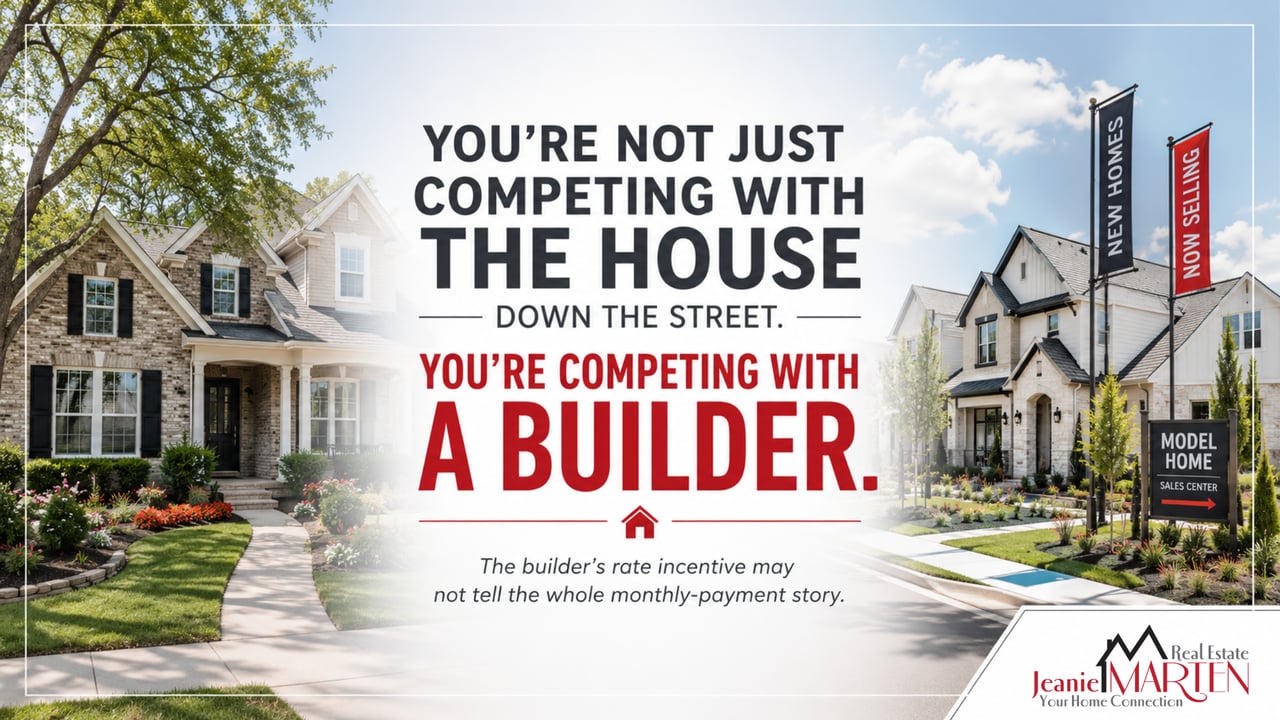
You're Not Just Competing With the House Down the Street. You're Competing With a Builder.
How do I sell my house when builders are competing with me? Compare the builder's total monthly cost, not their sale price. In many new North Texas communities a MUD or PID adds roughly $1.00 to $1.20 per $100 of value, enough to erase a rate buydown entirely.
Dallas-Fort Worth recorded 40,732 new-home closings in 2025, more than any other market in the country, according to Zonda's 2026 Local Leaders rankings. Houston was second at 37,513. Closings here fell 7.1% from the prior year and we still finished first.
If you're listing a resale home in North Texas, that number is your competition. Not the neighbor's house. A national homebuilder with a sales office, a preferred lender, a marketing budget and the ability to change the price of their product on a Tuesday afternoon.
The good news is that builders have a weakness and most sellers never learn to name it.
First: your situation depends entirely on where you are
This is the part generic advice gets wrong. Two North Texas sellers can face completely different markets fifteen minutes apart.
If you're in Sachse or Murphy, you barely have builder competition at all. Both cities are essentially built out. Sachse has no active new-home communities inside city limits, every listing that surfaces in a search for "new homes in Sachse" is actually in Wylie, Rowlett or somewhere farther out. Murphy is down to a couple of communities and almost no move-in-ready inventory. Your competition is other resale homes and your scarcity is a genuine asset. A buyer who wants an established Murphy neighborhood cannot get one from a builder at any price.
If you're in Lavon, Princeton, Royse City or Rockwall, the builder is genuinely down the street. These four have dozens of active new-home communities among them and a deep bench of quick move-in inventory, Lennar in Princeton, D.R. Horton in Royse City, Trophy Signature in Lavon, Perry in Rockwall. Wylie sits in the middle with moderate activity.
Everything below matters most to that second group. But the tax section is worth reading either way because it's the strongest argument the first group has too.
What the builder is actually offering
Know your competition's playbook before you price against it.
Builder incentives nationally have been running about 7% of purchase price, easing slightly from 7.5–7.6% in late 2025. The pre-pandemic norm was 2–3%. So incentives are still roughly two and a half times normal and John Burns Research notes Texas has among the highest concentrations of them in the country.
In DFW specifically, roughly 70% of new-home sales now include a rate buydown or structured incentive, getting buyers to an effective rate closer to 5.5%, well under the going market rate.
That's a real advantage and it would be silly to pretend otherwise. A buyer walking into a model home is being shown a monthly payment you cannot match on rate alone.
So don't compete on rate. Compete on the number underneath it.
The line the builder's payment sheet leaves out
Here's what most buyers (and a lot of agents) never check.
Many new master-planned communities in North Texas sit inside a Municipal Utility District (MUD) or a Public Improvement District (PID). These are financing tools that let a developer build roads, water and sewer up front and pass the cost to future homeowners through an additional annual tax or assessment. They are legal, disclosed and completely normal. They are also expensive and they do not appear on the glossy payment sheet in the sales office.
According to the Collin County Tax Assessor's 2025 rate summary, most Collin County MUDs add between $0.80 and $1.20 per $100 of assessed value. The most common figure is at the top of that range.
Take the clearest local example. Elevon in Lavon sits inside Elevon MUD #1A, which levies $1.20 per $100 on top of the city, county, college, and school rates:
Location | Total 2025 rate | On a $450,000 home |
|---|---|---|
Elevon (Lavon + Elevon MUD #1A) | ~3.06% | — |
Rockwall (Rockwall ISD) | 1.58% | $556/month less |
Murphy (Plano ISD) | 1.63% | $536/month less |
Lavon, outside the MUD | 1.86% | $450/month less |
Princeton (Princeton ISD) | 1.88% | $443/month less |
Wylie (Wylie ISD) | 1.95% | $416/month less |
Look at that fourth row again. Two homes in the same city, Lavon, can differ by about $450 a month in property taxes based solely on which side of a district line they sit on.
Now put that next to the builder's best offer. A 2-1 rate buydown on a $360,000 loan is worth roughly $457 a month in year one, about $234 in year two and nothing in year three.
The MUD is roughly $450 a month. It does not expire in year three.
The buydown is a two-year discount. The district obligation can run for decades, Celina's PID policy, for instance, allows a 30-year maximum term per development phase. That is the single most useful sentence a resale seller in an established neighborhood can put in front of a buyer.
Be honest about the caveats because your buyer's lender will be
We'd rather you make this argument accurately than aggressively:
- These are gross rates before homestead and other exemptions and the dollar figures are our arithmetic on a hypothetical $450,000 assessed value, not a published statistic.
- MUD rates typically decline over time as the district's debt amortizes and its tax base grows. They are not frozen at $1.20 for thirty years. The obligation is long; the rate usually isn't flat.
- PIDs work differently from MUDs. A PID is usually a fixed dollar assessment per lot rather than a rate per $100, and some homes sit in both.
- You must verify by address. Not every home in a master-planned community is inside the district and city limits don't tell you.
- And it doesn't universally favor established neighborhoods. Sachse, on the Garland ISD side, carries one of the higher total rates in the area at about 2.23%, above Lavon's base rate. The point isn't "old beats new." The point is that the tax line is a real variable that nobody checks and it frequently runs the other way from what the sales office implies.
The framework: how to actually compete
1. Go shop your competition in person. Walk the two or three nearest new-home communities. Get the current incentive sheet with an expiration date. Ask what's on their standing inventory, completed spec homes carry the deepest discounts. You cannot price against an offer you haven't read.
2. Build the honest total-payment comparison. Not price versus price. Principal, interest, taxes at the actual combined rate including any MUD or PID, insurance and HOA. Do it for their home and yours side by side. Sometimes you lose that comparison. It's better to know.
3. Price against their net, not their list. If a builder is offering $20,000 in incentives on a $450,000 home, their effective price is $430,000. Pricing your resale at $445,000 because "theirs is listed at $450" is how a listing sits for ninety days.
4. Lead with what a builder structurally cannot sell. Mature trees. A larger lot. An established neighborhood with no ongoing construction traffic. Window coverings, fencing, landscaping and a refrigerator, thousands of dollars of finish-out a new build doesn't include. And immediate occupancy, which matters enormously to a buyer whose lease is ending.
5. Consider matching their structure, not their price. A seller-paid rate buydown or closing cost credit often costs you less than an equivalent price reduction and lands harder in a payment comparison. Ask your agent to price both.
6. Present well or don't bother. You're being compared to a professionally staged model home with fresh paint and perfect lighting. Paint, declutter, deep clean and fix the small stuff. This is the cheapest ground you'll gain.
Where the resale market actually stands
Context for pricing, from June 2026 NTREIS data via MetroTex:
- Median sale price: $405,000, flat year over year
- Active listings: 31,914, up 4%
- Months of inventory: 4.4
- Average days on market: 54, up 4%
- Sellers received 95.5% of list price
And when North Texas sellers cut, the median reduction has been about $15,000, or 3.6% off the initial list price. That's the cost of guessing high and it's roughly what a well-built comparison would have told you before you listed.
Balanced conditions. Not a crash, not a frenzy. Priced right, homes are selling.
Frequently asked questions
Is now a bad time to sell a resale home in North Texas? It's a competitive time, not a bad one. DFW closed 40,732 new homes in 2025 (the most in the country) so builder competition is real. But new-home closings fell 7.1% year over year, resale inventory sits around 4.4 months, and sellers are still getting about 95.5% of list. Pricing and presentation matter more than timing.
What is a MUD or PID, and how do I find out if a home has one? Both are districts that finance infrastructure in newer developments and add to a homeowner's annual tax bill, a MUD as an added rate per $100 of value, a PID usually as a fixed assessment per lot. Check the county tax assessor's rate table and the appraisal district record for the specific address. Never assume based on the city.
How do I compete with a builder's rate buydown? Compare total monthly cost rather than rate. A 2-1 buydown is worth a few hundred dollars a month for two years and then ends, while a MUD or PID obligation on a new build can last far longer. You can also offer your own buydown or closing cost credit, which often costs a seller less than an equivalent price cut.
Let's see what you're actually up against
Before you set a price, we'll pull the active new-home communities within a few miles of your address, get their current incentives, and build the real payment comparison — including the tax rate on your home versus theirs. Sometimes that comparison is the whole listing strategy. Occasionally it tells you to wait, and we'll say so.
Visit MartenTeam.com or book a consultation.
If you enjoyed this blog, you might also find these interesting: PID vs. MUD in North Texas, Established Vs. Newer Neighborhood in Garland and the $500k North Texas Home Value Index
New-home closing data from Zonda's 2026 Local Leaders rankings via MetroTex; resale figures from NTREIS, June 2026. Tax rates are 2025 rates from the Collin County Tax Assessor and are gross of exemptions; monthly figures are illustrative arithmetic on a hypothetical $450,000 assessed value, not published statistics. Verify the district status and tax rate for any specific address with the appraisal district. Consult a tax professional regarding property taxes.