
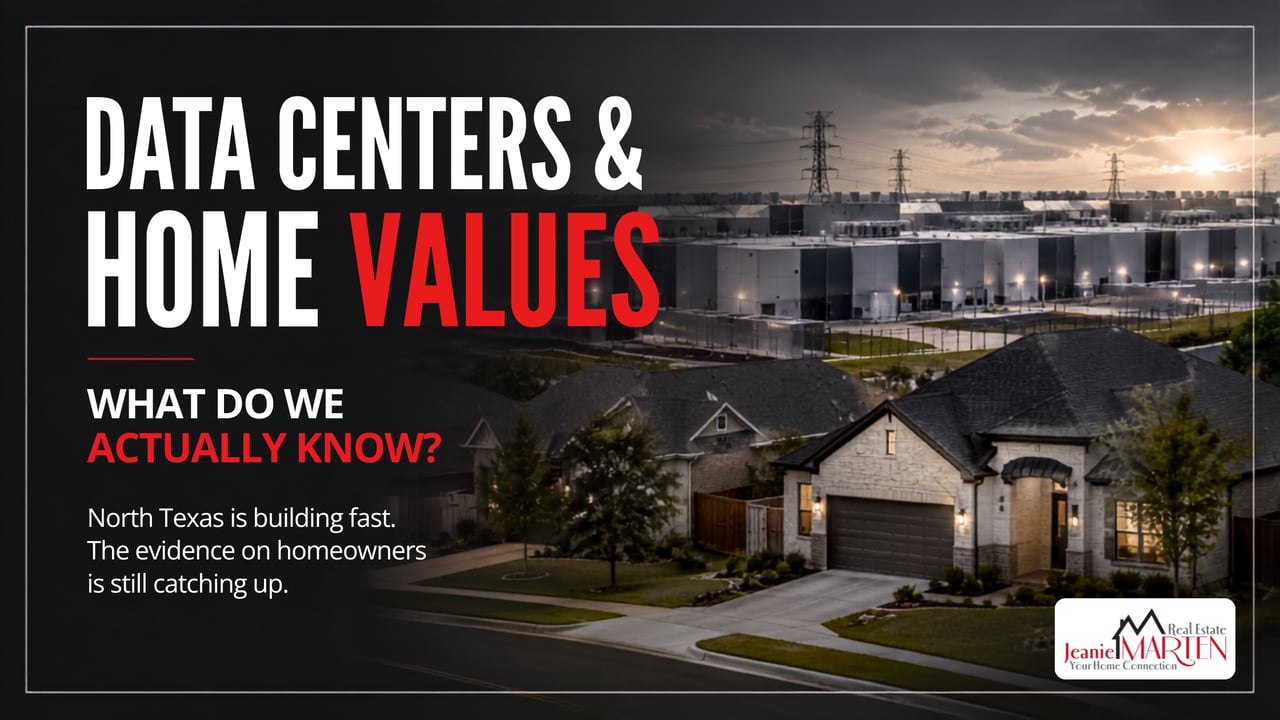
Data Centers in North Texas: The Honest Version
Do data centers hurt nearby home values? Nobody has proven it either way. As of August 2026 there is no peer-reviewed study on data center proximity and home prices, the evidence is a few unreviewed working papers and county-level data that can't answer a property-line question.
That's unsatisfying. It's also true and we'd rather give you that than a confident number we made up.
Data centers have become the most-opposed land use in America. In a May 2026 Ipsos survey for Redfin, 53% of Americans opposed data center construction in their neighborhood (more than opposed apartment complexes). A July 2026 Emerson College poll put opposition at 63%, up 21 points in seven months. And most of those same people use AI every day.
That tension is the story and North Texas is where it's playing out hardest.
Data Centers in North Texas: What Homeowners Should Know
A building full of computers, plus the infrastructure to power and cool them. The internet is not in a cloud. It's in a warehouse in Garland.
Three types matter here. Enterprise facilities run one company's own systems, State Farm has one in Richardson. Colocation landlords rent space and power to many tenants, like Equinix's Infomart on Stemmons. Hyperscale campuses serve a single operator: Meta, Google, Amazon. Those are the ones in the news.
The unit that matters is megawatts, not square feet. A neighborhood shopping center draws about one. A large hyperscale campus draws several hundred.
One distinction almost every news story blurs: crypto mining facilities are not AI data centers. The most alarming Texas stories (Granbury residents reporting nausea, migraines and insomnia from a facility less than 100 yards from a mobile home park) involve Bitcoin mining. Crypto mines are typically air-cooled with open fan arrays and weaker enclosure standards. They are genuinely louder. When someone shows you a horror story, check which kind it is. When Lavon approved data center use on a site in 2024, the council specifically prohibited crypto mining, local officials are already drawing this line.
Where DFW's data centers already are
This isn't hypothetical here. It's a mature industry that predates the AI boom by a decade.
Dallas-Fort Worth was the third North American market to pass one gigawatt of supply. Inventory hit roughly 1,249 MW by March 2026, up about 44% year over year, with vacancy at 1.8% ,essentially full. In August 2026 Cushman & Wakefield ranked Dallas the #1 data center market in the world out of 107. Being precise about that headline: it's a growth-potential ranking. Northern Virginia is still far larger by operating capacity.
Operating now: Equinix and Digital Realty in Dallas; Digital Realty, State Farm and LinkedIn in Richardson (~85 MW); Meta in Fort Worth since 2017; Google in Midlothian since 2019 and Red Oak since November 2025; Aligned in Plano (~60 MW); QTS in Irving; CyrusOne in Carrollton; NTT and Digital Realty in Garland. The Texas Comptroller keeps a public list of certified data centers — worth knowing it exists.
Closer to home, activity is newer: a 200 MW campus proposed in Kaufman County, a Flexential campus on 110 acres also in Kaufman County and Hunt County's first AI data center (roughly 430 MW on a site near FM 1564) energizing in 2027.
The economic case and the honest critique
A host city gets a large capital investment, a real property tax base, two to three years of construction employment and community grants.
Meta's Fort Worth facility is the local benchmark: $1.5 billion-plus invested, roughly 1,200 trade workers at peak construction and 200-plus permanent jobs, with $5.2 million in direct funding to area schools and nonprofits since 2018.
Now the part the ribbon-cuttings skip.
Permanent employment is low relative to investment. You don't need a critic's word for it, look at what Texas requires. To claim the state sales tax exemption, a data center needs 20 permanent jobs for a $200 million investment, or 40 jobs for $500 million. That's the state's own expectation, written into statute.
The subsidies are large and growing. That exemption (covering equipment and, crucially, electricity) cost roughly $1.3 billion in fiscal 2026, up from $5–30 million a year a decade ago, across about 121 facilities. Good Jobs First projects Texas forgoes roughly $9 billion between 2025 and 2030. At a July 28, 2026 Senate Finance hearing, Chair Joan Huffman called the numbers "extremely concerning and I will say they're unsustainable." Of 20 projects audited, six were noncompliant or withdrew.
The employment research is mixed. Economist Michael Hicks found data center employment effects in Texas "effectively zero," while Brookings found county private employment rose 4–5% over five to six years after a first large facility.
Fair summary: the tax base benefit is real, the job benefit is small and whether the trade was good depends on what your city gave away to get it.
Power and water — where we'll admit our bias
This is where Jeanie Marten Real Estate has an actual opinion, so we'll flag it rather than smuggle it in.
We're not against data centers. But power and water are the two genuine limiting factors on North Texas growth (they determine whether the next 100,000 households can be housed here) and data centers draw hard on both. That's a growth-capacity concern more than an environmental one.
Power. ERCOT set a record peak of 91,089 MW on July 22, 2026. The large-load interconnection queue reached about 474 GW by June 2026, roughly 90% of it data centers.
Read that number carefully, because it gets abused. The queue is not a forecast, it's full of duplicate requests from the same project shopping multiple sites, which is why state law now requires developers to disclose that. Anyone telling you 474 GW is coming to Texas isn't being straight with you. ERCOT's actual projection is roughly 368,000 MW of demand by 2032, still about four times today's peak.
Water. Texas data centers will use about 25 billion gallons in 2025 (0.4% of state water use) projected to reach 2.7% by 2030, per the Texas Tribune. That's roughly 1.3 million households.
Cooling design matters more than anything else here:
- Evaporative cooling is energy-efficient but up to 85% of the water evaporates and never returns.
- Closed-loop uses a large one-time fill and minimal ongoing draw. The Stargate facility in Abilene took about 8 million gallons to fill, against a city supplying 22 million gallons a day.
- Air cooling uses almost no water and significantly more electricity.
You cannot minimize water and power at once. That's the real engineering constraint and it's the right question about any specific proposal. Two local examples show it can be done well: CyrusOne's Carrollton facility uses zero-water cooling, and Flexential's planned Kaufman County campus is designed closed-loop.
Here's what genuinely worries us: Texas requires data centers to report historical water use but prohibits forecasting future usage or identifying sources. About a third of 70 surveyed facilities complied in 2024 and data centers won't appear in state water plans until 2032. We're building the largest new water demand in a generation and have excluded it from the state water plan for six more years.
The rules, state and local
Counties cannot zone. Cities can.
Understand this first because it determines everything: Texas counties have no zoning authority. A county cannot block a data center, impose setbacks or deny a project over water. Cities have full zoning power. If a site is inside city limits, there are rules. If it's unincorporated, there essentially aren't. That's why Hunt County commissioners, having no tools, passed a resolution in April 2026 asking the state for a pause, a resolution with no regulatory force.
At the state level
Senate Bill 6, effective June 2025, governs loads of 75 MW or more. It requires a $100,000 interconnection study payment, demonstrated site control, disclosure of duplicate requests elsewhere, and (most significantly) for interconnections after December 31, 2025, equipment allowing ERCOT to curtail the facility during grid emergencies. In plain terms: new large data centers can be told to power down before your house is.
Then it accelerated. In June 2026 Governor Abbott directed regulators to make data centers fund their own grid infrastructure rather than pass costs to residential ratepayers. On August 3, 2026, he ordered an audit of every project in the interconnection queue before any new approvals, effectively a freeze. Developers must now disclose tax breaks, power plans, water use and cooling design and community impact mitigation. Projects failing verification are denied grid connection.
The Legislature isn't in session until 2027, but data centers sit on multiple interim charges and the Speaker has named them a priority. Expect these rules to change again.
In the cities we serve
Princeton is the news hook and it's confirmed. On August 10, 2026, the City Council approved amendments limiting data centers to the M-2 Heavy Manufacturing District with a Specific Use Permit, revising the city's definition and establishing use-specific development standards. An SUP means every project gets a public hearing, neighbors get a say. The detailed standards weren't posted publicly at this writing; request the ordinance from Princeton Development Services if you want setback and noise numbers.
Lavon deserves the most homeowner attention and is getting the least. In December 2024, Lavon adopted an ordinance permitting data center use on Elevon Parcels 8 and 9 (roughly 79 acres southwest of FM 2755 and Watkins Road) at 85 feet of height and 75% lot coverage, with crypto mining prohibited. No buyer is under contract and the Lavon EDC has been actively marketing the site to hyperscale users. Then on August 6, 2026, the council put a temporary data center moratorium on a special meeting agenda. The outcome wasn't posted publicly as of this writing. If you own in or near Elevon, that's the most consequential local government action affecting you right now and a call to Lavon City Hall beats any article.
Wylie approved zoning in May 2026 on about 60 acres near Sanden Boulevard and West FM 544 that included limits on a potential data center, a site-specific condition, not a citywide ordinance.
For Sachse, Murphy, Royse City, Rockwall, Nevada and Josephine, we found no data center ordinance or moratorium. Read that carefully: small-city actions often don't surface in a search and "no rule found" isn't "no rule." Call the planning department, it's a five-minute call (keep build out in mind, does Sachse or Murphy really have room for one?).
Elsewhere, Fort Worth voted unanimously on August 11, 2026 to begin a moratorium process and Dallas council members have asked for hearings because data centers are currently allowed by right in many non-residential districts. A cautionary tale: Hill County enacted the first Texas county moratorium in May 2026 and rescinded it three weeks later after a $100 million developer lawsuit. Cities that work through zoning stand on firmer ground than cities that slam a door.
So what happens to home values?
Here we have to be more careful than most of what you'll read.
There is no peer-reviewed literature on data center proximity and home values. Anyone saying "studies show", in either direction, is overstating what exists.
The best evidence for harm is a January 2026 working paper from George Washington University studying Loudoun County, Virginia, the densest data center market on earth. Using a difference-in-differences design around announcements, it finds homes within half a mile sell for about 2.8% less than similar homes slightly farther out. It's the only study designed to support a causal claim at the distance that matters and it's unreviewed, single-county and never replicated.
The best evidence for no harm is an August 2026 Realtor.com analysis matching 43 ZIP codes that gained a large data center between 2019 and 2025 against comparison ZIPs. Values moved in line with their matches.
These findings do not actually contradict each other. A ZIP code can cover 40 square miles. Average a penalty on the 200 homes within half a mile across 8,000 homes and you get approximately zero. The "no effect" studies measure at a scale too coarse to detect what homeowners are actually asking about. That scale confusion is the most common error in coverage of this topic, in both directions.
Be skeptical of the rest. A widely-cited George Mason report found homes closer to Northern Virginia data centers sold for more but it's one year of cross-sectional data with no before-and-after, so it can't separate "data centers raise values" from "data centers get built where values were already high." An industry-commissioned Indiana analysis showing no harm covered about 80 homes. One circulated Virginia figure rests on seven sales. And critics ignore a real offsetting mechanism: data center revenue has let two Virginia counties cut property tax rates, which gets capitalized into home values.
What genuinely isn't known is the useful part:
- Nobody has estimated a distance-decay curve — 500 feet versus a quarter mile versus a mile. That's the exact question every homeowner asks.
- No study links measured noise to prices, despite forty years of mature hedonic research on airport and highway noise. County-commissioned acoustic work in Virginia found low-frequency tonal noise near 90 Hz that is likely audible indoors and becomes more distinguishable farther out, as broadband sound falls off faster than the tone. That's why residents describe a hum meters seem to understate, and why ordinances written for block parties fail here.
- Nobody has looked at days on market or concessions. Realtor.com did find data center areas retained 66% of pre-opening active listings after three years versus 43% in matched areas. In thin markets, a disamenity (appraisal and economics jargon for the opposite of an amenity) usually shows up in how long homes take to sell before it shows up in price. That may be the most important unstudied question for a North Texas seller.
- It's all backward-looking and mostly Northern Virginia, a high-income market where data centers are normalized. Siting is now moving toward less dense, lower-income areas, which describes a lot of our eastern Collin, Hunt and Kaufman County corridors.
Our read: the evidence is consistent with regionally neutral-to-positive, locally negative within a few hundred yards. A mile away, there's little reason to worry. Looking at cooling equipment across a fence line, absence of proof is not proof of absence and we'd treat it as a real risk nobody has measured yet.
If one is proposed near you: the playbook
1. Find out what's actually proposed. Call the city's planning department and ask for the case file: acreage, megawatt capacity, cooling design, setbacks, site plan. In unincorporated areas, call the county and know they may have no authority.
2. Learn which approval it needs. By-right development means no hearing and no leverage. A specific use permit or rezoning means hearings and a real chance to shape conditions. Princeton just moved data centers into the SUP category to create that step.
3. Get on the notice list. Cities notify owners within a set distance, often 200 feet, far too small to include everyone affected. Ask the city clerk how to get notice anyway.
4. Go to Planning & Zoning, not just City Council. P&Z is where conditions get written. By council, most of the substance is settled.
5. Ask questions that can become permit conditions. Vague opposition is easy to dismiss. These aren't:
- What's the cooling design (evaporative, closed-loop, or air) and projected annual water use?
- What's the decibel limit at the property line, measured how, and does it cover low-frequency noise? A dBA-only standard misses the actual complaint.
- Are emergency generators covered by the noise standard and how often are they load-tested?
- What are the setbacks, screening and maximum height from residential property?
- Is there a tax abatement and what does the city get for it?
- Who pays for transmission and substation upgrades?
- Is there a cumulative standard if a second and third campus follow?
6. Ask about the tax deal. Chapter 312 abatements are negotiated by cities and counties and are public record. If your city is granting one, you can see the terms.
7. Know the legal limits. A city can zone, condition and set standards. Hill County shows an outright ban invites litigation. Strong, defensible conditions usually beat pushing for prohibition.
Frequently asked questions
Are data centers being built in Sachse, Wylie, Murphy or Lavon? Lavon has a site on the Elevon parcels approved for data center use since December 2024, though no buyer is under contract and the council took up a moratorium in August 2026. Wylie attached data center limits to one rezoning in May 2026. We found no ordinances or active proposals in Sachse or Murphy but city planning departments are the authoritative source.
Will a data center lower my home's value? No one can tell you honestly, because the research doesn't exist. The one working paper measuring within half a mile found about a 2.8% discount in Northern Virginia; broader ZIP-level analyses find no effect but are too coarse to detect a near-field impact. Distance is almost certainly what matters most and nobody has mapped how the effect changes with it.
Why is Texas suddenly slowing data centers down? Grid capacity. Governor Abbott ordered an audit of the entire interconnection queue in August 2026 before any new approvals, after it reached roughly 474 GW (about 90% data centers) against a record peak demand near 91,000 MW. The state is also reexamining the sales tax exemption that cost about $1.3 billion in fiscal 2026.
Where we land
We're not going to tell you data centers are good or bad. They're a land use and land uses are good or bad depending on where they go, how they're built and what the city negotiated.
What we will say: power and water are the real ceiling on North Texas growth. Land, jobs, people wanting to move here, we have those in abundance. If those two constraints tighten, it affects every homeowner in Sachse, Wylie, Murphy, Lavon, Royse City and Rockwall, whether or not a data center is ever built within ten miles of you. That's a bigger issue than any single project and it deserves more attention than it gets.
If you're buying near a proposed site, selling near an existing one or just want to know what's filed in your city, we'll help you find out.
Visit MartenTeam.com or book a consultation.
If you enjoyed this blog, you might also find these interesting: What Retail Development Really Does to Home Values in North Texas, Living In Elevon Near Lake Lavon and Lavon, TX Is No Longer Just Country Living.
Current as of August 14, 2026. Texas data center regulation is changing rapidly at the state, county, and city level — verify current status with your city before relying on any regulatory detail here. General information, not legal, tax, or investment advice.