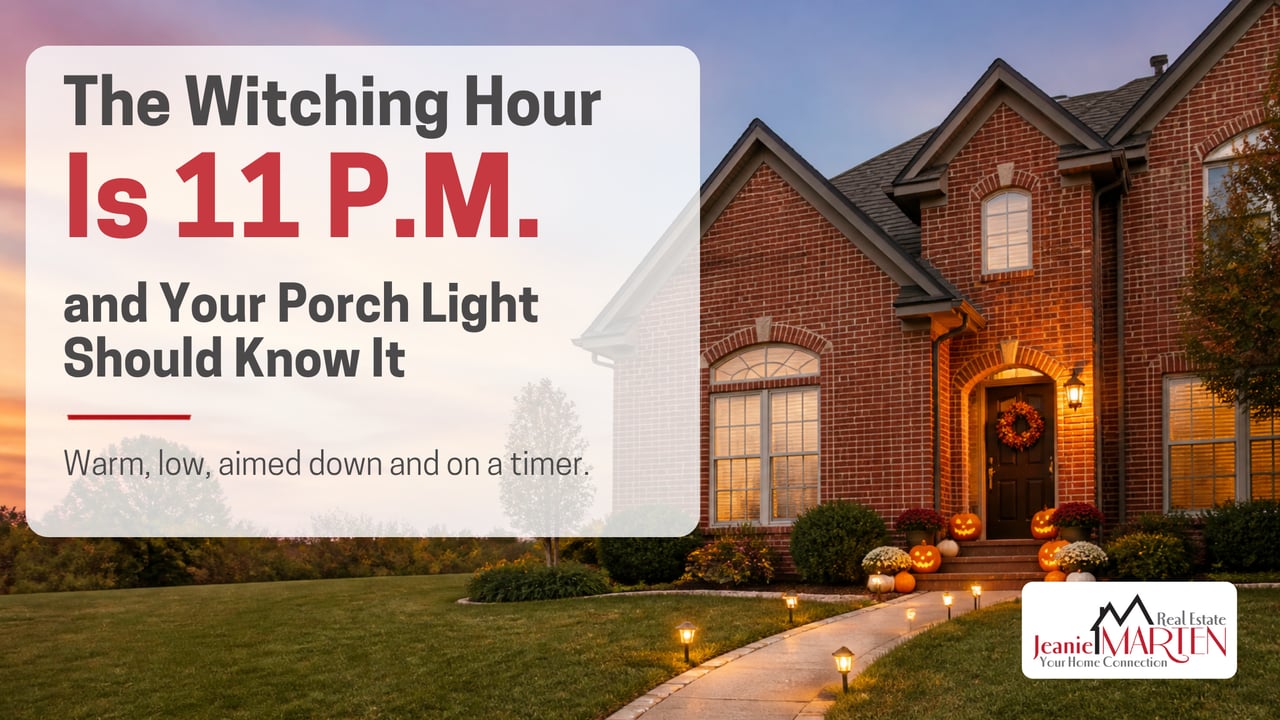
How should you light a house at night for curb appeal? Aim light down, keep it warm at 3000K or lower, use timers and motion sensors and light the path and entry rather than the whole yard. Less light aimed well beats more light everywhere.
The sun sets before six now, which means for the next several months a large share of the people who drive by your house will only ever see it in the dark.
They will see it when they leave work. They will see it when they drive through the neighborhood deciding whether they want to live here. If you have a listing, they will see it on the way to the showing. And most houses in Sachse, Wylie, and Murphy look, at night, like a dark shape with one yellow bulb by the garage.
So let's fix that. And while we do it, let's not blast the sky, because right now that matters more than most people realize.
First, the thing almost nobody knows
Texas sits on the Central Flyway and roughly one out of every three or four birds migrating across the United States passes through this state. Most of them fly at night.
Artificial light disorients them. Birds navigating by starlight get pulled off course toward lit areas, where they circle, exhaust themselves and collide with buildings and windows.
Which is why Lights Out Texas exists. The campaign asks people to turn off non-essential lights from 11 p.m. to 6 a.m. during migration. Fall migration runs August 15 through November 30, with the peak from September 5 through October 29.
So the witching hour is real, it is 11 p.m. and the thing at stake is not your soul. It is several million birds crossing over Northeast Dallas in the dark.
Read those dates against your calendar. We are in it right now and it runs through the end of November.
The campaign asks two specific things of homeowners beyond turning lights off. Do not use landscape lighting to illuminate trees or gardens because those are exactly where birds rest. And close your blinds at night, because interior light spilling out through big windows is a significant source.
Here is the part I like: almost everything that helps birds also makes your house look better. Badly aimed light is bad lighting. Turning off the floodlight at midnight is not a sacrifice.
The five rules that make lighting look good
DarkSky International publishes five principles for responsible outdoor lighting and they double as a decent design brief. Their language:
Useful. Use light only if it is needed. Targeted. Direct light so it falls only where it is needed. Low level. Light should be no brighter than necessary. Controlled. Use light only when it is needed. Warm-colored. Use warmer-color lights where possible.
Every bad exterior lighting job in your neighborhood violates at least three of those and it looks bad for exactly that reason. A blue-white floodlight bolted under the eave, aimed sideways, running all night, lighting the neighbor's bedroom window as a bonus. Nobody ever looked at that house and thought it looked expensive.
What to actually do
Buy warm. Look for 3000K or lower on the box. DarkSky's own certification standard caps approved fixtures at a nominal 3000K and I would go to 2700K for anything near the front door. Blue-rich white light is the harshest thing you can put on a brick house, it makes everything look like a parking lot, and it is the worst of it for wildlife. The color temperature is printed on every bulb package. Check it.
Aim it down and shield it. If you can see the bulb from the street, the fixture is throwing light where nobody needs it. Shielded fixtures that cast light downward put the light on the thing you want lit and keep it out of your neighbor's window and out of the sky. This single change does more for how a house looks at night than any amount of added wattage.
Light the path and the entry, not the whole yard. The goal is to show people where to walk and where the front door is. Low path lights along a walkway and something warm at the entry will do more for a listing photo than eight fixtures blasting the facade.
Put it on a control. Motion sensors for security lighting, timers for everything else. This is the rule that does the most good and costs the least. A motion-activated light at the side gate is genuinely more useful for security than one that burns all night, because a light that comes on suddenly is a light people notice.
Skip the uplighting on trees, at least through November. I know. Uplit trees look wonderful and I am not going to pretend otherwise. But that is the specific thing the campaign asks people not to do because those trees are where migrating birds land to rest. If you want it for the holidays, you are clear after November 30.
Close the blinds. Free, takes thirty seconds and cuts a real amount of light spill from big rear windows.
If you are listing this fall
A few things specific to selling.
Get one twilight photo. Not the whole gallery, just one. A single well-lit dusk exterior is the most scroll-stopping image most listings can get and a house photographed at dusk with warm, targeted lighting reads as cared for. It supports everything in What Buyers Notice in the First 8 Seconds, which applies to the photo just as much as to the front door.
Replace the mismatched bulbs. Two warm bulbs and one cold blue one on the same facade is the most common exterior lighting mistake I see and it shows up brutally in photos. Same color temperature everywhere, every time.
Check what the camera sees at 6 p.m. Stand across the street at dusk the week before photos. That is your listing's first impression from November through February.
Do not overdo it. A house lit like a used car lot reads as trying too hard and buyers cannot tell why they dislike it. Warm, low, and aimed beats bright every time.
The version I actually want you to take away
Good exterior lighting is not about how much light you add. It is about how little you need when it is aimed correctly and the right color.
That is true for curb appeal, it is true for your electric bill, it is true for the neighbor whose bedroom faces your driveway and right now through the end of November it is true for a very large number of birds passing over Northeast Dallas in the dark.
Warm, low, down and on a timer. That is the whole thing.
Frequently asked questions
What color temperature should outdoor lighting be? 3000K or lower. DarkSky's certification standard caps approved fixtures at a nominal 3000K, and 2700K is warmer and generally more flattering on brick and stone. The number is printed on the bulb packaging, and mixing color temperatures on one facade is the most visible common mistake.
When is Lights Out Texas and what does it ask? Fall migration runs August 15 through November 30, with peak migration September 5 through October 29. Spring runs March 1 through June 15, peaking April 22 through May 12. The ask is to turn off non-essential lights from 11 p.m. to 6 a.m., avoid lighting trees and gardens where birds rest, and close blinds at night.
Does exterior lighting help sell a house? It helps in two specific ways. It makes drive-bys and evening showings far more favorable during months when most people see a house in the dark, and it enables a twilight listing photo, which is one of the highest-performing images a listing can have. Aim for warm, targeted, low-level light rather than maximum brightness.
If you found this useful, read these next
- Boost Your North Texas Curb Appeal with Native Annuals and Perennials is the daylight half of the same project, using plants that survive here.
- 5 Red Flags in Listing Photos That Most Buyers Scroll Right Past covers what your photos are accidentally telling buyers.
Happy Halloween from Jeanie Marten Real Estate. If you are thinking about listing this winter, walk out to the street at dusk one evening this week and look back at your house. Then call me and tell me what you saw. That is usually the whole conversation.
Visit MartenTeam.com or book a consultation.
Jeanie Marten Real Estate 972-414-0719 | MartenTeam.com