
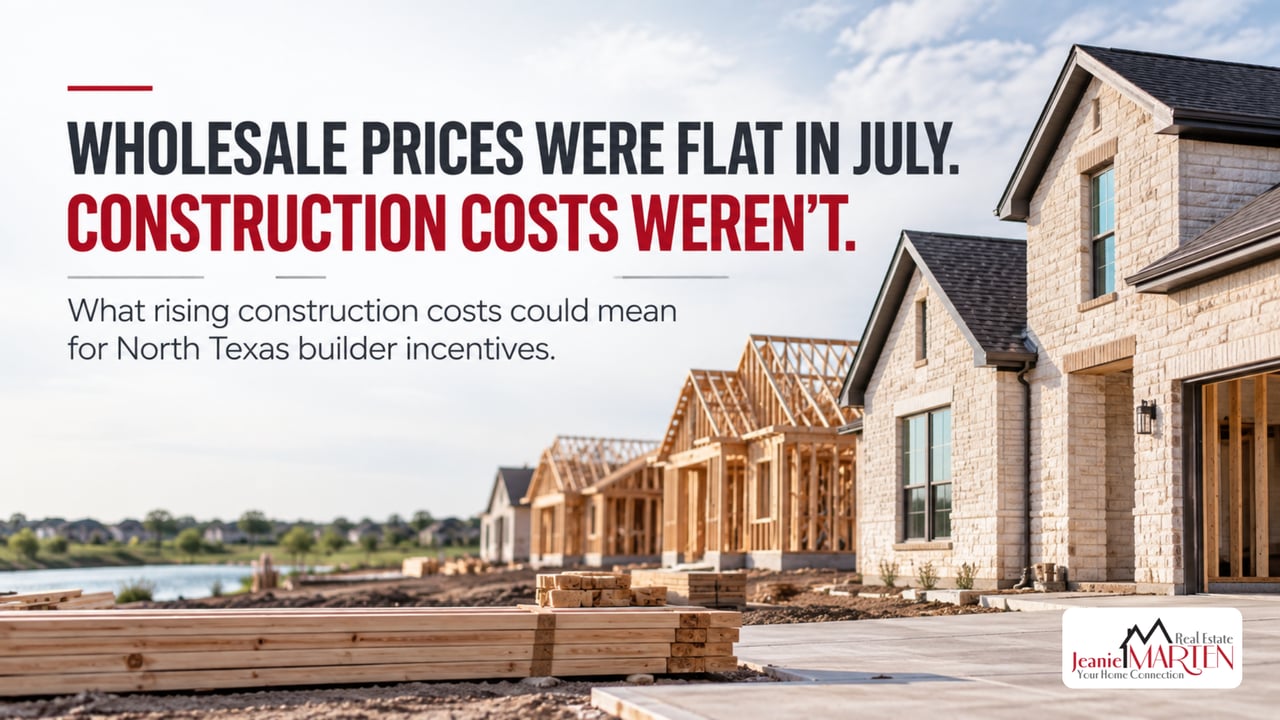
What did the July 2026 PPI report say about construction costs? Producer prices were unchanged overall in July 2026 but final-demand construction prices rose 2.2% for the month and lumber jumped 5.0%. Annual wholesale inflation is running 4.7%.
If you're shopping a new build in Lavon, Royse City or the new sections going up around Wylie, that 2.2% is the number to pay attention to and not for the reason you'd think.
It is not, primarily, about the sticker price of the house. Builders don't reprice a standing inventory home overnight because lumber moved. It's about the incentive sheet, the rate buydown, the closing cost credit, the free upgrade package. Those things come out of builder margin. And margin is exactly what rising input costs eat first.
Right now, incentives in North Texas are the best they've been in years. This report is the first real signal that the pressure holding them up is starting to work in the other direction.
What the report actually said
The headline number was a non-event. Underneath it, the components split hard:
July 2026 PPI, final demand | Monthly change |
|---|---|
Overall | Unchanged |
Goods | −0.7% |
Services | +0.2% |
Construction | +2.2% |
Lumber (processed goods) | +5.0% |
Annual wholesale inflation: 4.7%
Read that table again. Goods prices fell seven-tenths of a percent and the overall index still came out flat because construction climbed enough to cancel it out. The Bureau of Labor Statistics specifically credits the 2.2% construction advance with offsetting the decline in goods.
So "wholesale inflation was flat" is technically true and practically misleading. If you build houses for a living, July was not flat. July was expensive.
Why a builder's cost problem becomes your timing problem
Here's the part that connects a wholesale price index to your actual purchase.
For the past couple of years, builders across North Texas have competed on incentives rather than on list price. There's a reason for that, cutting the list price on one home resets the comps for the whole section and it makes every buyer already under contract unhappy. Handing one buyer a $15,000 closing credit does neither. So the discount moved off the price tag and onto the incentive sheet.
Those incentives are funded out of the gap between what a house costs to build and what it sells for. When framing lumber goes up 5% in a single month and the broader construction input index goes up 2.2%, that gap narrows. The builder has three options: raise prices, accept thinner margin or quietly trim the incentive.
The first one is slow and visible. The second one has a floor. The third one happens in a sales office on a Tuesday with no announcement at all.
The window you're shopping in right now
Nationally, this is a genuinely unusual moment for new construction. Per the National Association of REALTORS®, roughly 40% of builders have cut prices, with typical reductions around 5% and close to two-thirds are offering additional incentives on top; rate buydowns, upgrade packages, closing cost help.
The result is something we almost never see: the median newly built home is currently priced below the median resale home. New construction normally carries a 10–15% premium. That premium has been erased by incentives and by builders concentrating in lower-cost outer markets which, in the Dallas-Fort Worth area, describes exactly the eastern Collin, Rockwall and Hunt County corridors where a lot of our clients are looking.
That's the window. Rising material costs are the first thing we've seen that could start closing it.
Not all incentives are worth the same and this is where people get it wrong
If incentives are going to get tighter, the shape of the one you take matters more than the headline value. Run the math on a $400,000 new build with 20% down, a $320,000 loan at 6.74%, principal and interest of about $2,073:
Option A — a 2-1 rate buydown (roughly $7,400 in builder cost) Year one payment drops to about $1,667. That's $406 a month in relief, which feels enormous. Year two it's $1,865, or $208 a month. Year three, you're at the full $2,073 and the help is gone.
Option B — a $20,000 price reduction Your loan drops to $304,000 and the payment lands around $1,970. That's $104 a month, a quarter of what the buydown gives you in year one.
The buydown wins the first two years. The price cut wins everything after that: about $104 a month for 360 months, roughly $37,000 in interest and principal over the life of the loan. And in Texas, a lower purchase price also means a lower taxable value. At a combined rate north of 2% (common across our area, though it varies by district) a $20,000 reduction is worth another $400-plus a year, every year, for as long as you own the house.
Our take: if a builder gives you the choice, take the price reduction unless you have a specific, concrete reason to need cash flow in years one and two, a spouse finishing school, a business ramping, a second income starting. The buydown is designed to feel bigger than it is. It's a two-year discount priced like a permanent one.
One month is one month
We'd be doing you a disservice if we let this sound more urgent than it is.
Lumber is one of the most volatile series in the entire index, pull up the historical lumber PPI series and you'll see moves like this reverse themselves regularly. A 5% month is not a trend. Builders also buy materials on contracts negotiated months ahead, so July's wholesale prices don't hit a job site (or a sales office incentive budget) in July. There's a lag, and it's measured in months, not days.
So this is not a reason to panic-buy a house you haven't thought through. Buying the wrong home in Royse City to beat a lumber print is a much more expensive mistake than losing a $10,000 credit.
What it is: a reason to stop treating today's incentive package as a permanent feature of the market. If you've been slow-walking a new construction decision on the assumption that the deals will still be there in the spring, that assumption just got its first real challenge.
If you're shopping new construction in North Texas, do these five things
- Get the full incentive in writing, with an expiration date. Verbal incentive terms in a model home are worth nothing. Ask what expires and when.
- Ask what happens if your closing slips. On a to-be-built home, find out in writing whether the incentive survives a construction delay. This is the single most common place buyers get hurt.
- Compare the builder's buydown against an outside quote. Builder incentives are usually tied to their affiliated lender. That's legal and often still a good deal but you can't know that without a competing quote in hand. Get one.
- Look hard at standing inventory. Completed spec homes carry a builder's money every day they sit. That's where the deepest incentives live and where they get trimmed last.
- Bring your own inspector anyway. New does not mean flawles and an incentive package is not a substitute for an independent inspection. We've never regretted ordering one.
Frequently asked questions
Will new construction prices go up because of rising material costs? Not immediately. Builders buy materials months ahead on contract, so July's wholesale increases take time to reach sale prices. The faster effect usually shows up in incentives (smaller closing credits and less generous rate buydowns) rather than in higher list prices.
Are builder incentives better than a price reduction? Usually not, over the full time you own the home. A temporary rate buydown gives you a bigger monthly benefit for two or three years, while a price reduction gives you a smaller monthly benefit permanently, plus a lower taxable value in Texas. Compare the total, not the first year.
Should I buy a new home in North Texas now or wait? That depends on whether you're ready, not on the PPI report. What this data suggests is that the unusually strong incentive environment across the Dallas-Fort Worth area is more likely to tighten than to improve. If you were already close to a decision, that's worth factoring in. If you weren't, one month of lumber prices is not a reason to move.
Let's look at what's actually on the table
Incentive packages in North Texas vary enormously between builders, between communities, and even between two homes in the same section depending on how long they've sat. We track what's being offered across Sachse, Wylie, Murphy, Lavon, Royse City and the surrounding areas, and we'll tell you honestly when a deal is as good as it looks and when it isn't.
Visit MartenTeam.com or book a consultation.
Producer price data from the U.S. Bureau of Labor Statistics July 2026 PPI report, released August 13, 2026. Payment examples are principal and interest only and exclude taxes, insurance, and HOA dues; buydown costs are approximate. Property tax rates vary by taxing district. Jeanie Marten Real Estate does not originate loans, consult a licensed mortgage professional for rate quotes and a tax professional regarding property taxes.
If you enjoyed this blog, here are a few more you might like: How to Evaluate a Home Builder in North Texas, 9 Questions to Ask During a New Construction Walkthrough and Should You Use a Realtor for New Construction in Texas.