
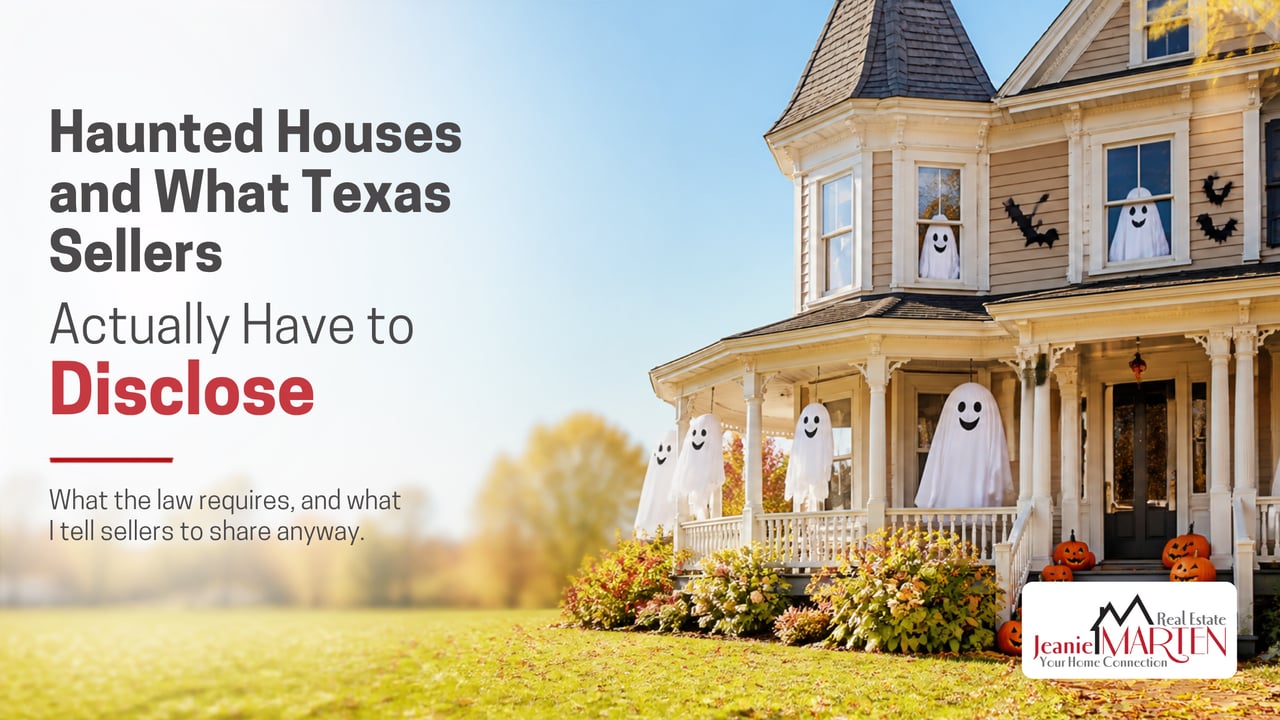
Do you have to disclose a death in a house in Texas? Not for death by natural causes, suicide, or an accident unrelated to the property's condition. Murder and deaths caused by the property itself are different, and a direct question from a buyer changes everything.
It is the week of Halloween so let's talk about the question I get asked more often than you would think, usually in a lowered voice.
Somebody died in the house. Do I have to tell anyone?
The legal answer is narrower than most people expect. My actual advice is broader. Both are worth understanding because the gap between them is where sellers get into trouble.
What Texas law actually says
The governing language is Texas Property Code Section 5.008, which is the statute behind the Seller's Disclosure Notice you fill out when you list.
Subsection (c) is the part that matters here. A seller and a seller's agent have no duty to disclose whether a death occurred on the property by natural causes, suicide or an accident unrelated to the condition of the property.
So the grandmother who passed peacefully in the back bedroom at 94 is not something the law requires you to put on a form. Neither is a death from illness. The statute treats these as information that does not bear on the condition of the house, which, as a matter of building science, is correct.
That is the whole exemption. It is narrow and it is worth noticing what it leaves out.
What you do have to disclose
Murder. Homicide is not in that list. If you know a murder occurred in the home, it should be disclosed and that holds even if it happened before you owned the house. The exemption simply does not cover it.
Any death the house itself caused. If someone died because of a condition of the property, a faulty gas appliance, an electrical fire, a defective pool gate, that is material and it gets disclosed. This is true even if the problem was fixed afterward. In fact especially then because the repair is part of the house's history and a buyer is entitled to know what was repaired and why.
Anything a buyer asks you directly. This is the one people miss and it overrides everything above. The exemption relieves you of a duty to volunteer. It does not give you permission to lie. If a buyer asks whether anyone has died in the home, you answer honestly. An untrue answer is misrepresentation and misrepresentation is a completely different legal problem than nondisclosure.
That applies to agents too. Under TREC rules, an agent who knows about a death has an obligation not to misrepresent it.
And now my actual advice
Here is where I part ways with what the statute permits.
Disclose it anyway. Before your neighbors do.
I want to be very clear that I am not describing a legal requirement. I am describing what happens in real neighborhoods, which is that people talk. Your buyer will meet the neighbors. Someone will mention it over the fence within the first month, usually while being perfectly kind about it and your buyer will feel like they were the last to know.
They will not be reasoning about Property Code Section 5.008. They will be standing in a house they just bought, thinking that you knew and did not say.
Even the Texas Real Estate Research Center at Texas A&M, which writes about this from a legal and professional standards angle, lands on full disclosure as the better practice, for exactly this reason. Neighbors are going to tell them.
Some buyers care and that is allowed
The other thing I want to say plainly: some buyers are genuinely bothered by a death in a house, including a completely ordinary one from natural causes and that is their business.
People have beliefs. People have superstitions. People have a grandmother who told them something when they were seven that they never quite shook. None of that is silly and it is not my job or yours to talk somebody out of how they feel about a house they are going to sleep in.
A buyer who finds out before closing and is uncomfortable can walk during the option period. That costs you a few weeks. A buyer who finds out after closing and feels misled is a different kind of problem and there is no option period for resentment.
How to disclose it without hurting your sale
The way you say it matters more than whether you say it.
Say it early and say it plainly. In the agent conversation before the house goes live, not in week three of negotiations. I ask sellers for everything up front for exactly this reason, which is something I get into in The Conversation I Have With Every Seller Before We Ever Talk About Price.
Give the real context. "My father passed away here in 2019 after a long illness, in hospice care, in his own bed" is a completely different sentence from a blank space where information should be. The first one is a family's story. The second one is a mystery and mysteries grow.
Do not editorialize. You are not required to apologize for it or to argue that it should not matter. State the fact, answer questions honestly, and let the buyer decide.
Let your agent handle delivery. There is a professional way to raise this that does not turn it into a whispered rumor and getting it into the conversation deliberately is far better than having it surface accidentally.
In my experience, most buyers hear it, say something kind and keep walking through the house. The ones who cannot get past it were always going to find out and it is better for everyone that they find out now.
What about actually haunted?
Texas does not have a paranormal disclosure statute, which I suspect disappoints some of you.
That said, the same rule applies as everywhere else in this post. If a buyer asks you a direct question, answer it truthfully. If you genuinely believe something unusual happens in the house, saying so is not required but lying about it is a bad idea.
Mostly, though, what people call a haunted house is a house with settlement noises, an HVAC system or a water heater that rumbles. Which is a topic for another day this week.
Frequently asked questions
Do you have to disclose a death in a house in Texas? Not if the death was by natural causes, suicide or an accident unrelated to the property's condition. Texas Property Code Section 5.008 removes the duty to disclose those. Murder and deaths caused by a condition of the property are not covered by that exemption and a direct question from a buyer must be answered truthfully regardless.
What happens if a buyer asks and the seller lies? That moves the situation from nondisclosure, which may be permitted, to misrepresentation, which is not. Answering a direct question untruthfully creates legal exposure for both the seller and any agent who participates in it.
Does a death in the home affect resale value in North Texas? It depends entirely on the buyer and the circumstances. An ordinary death from natural causes usually has little effect once it is disclosed calmly and early. A violent or widely publicized event is a different situation and is better handled with a pricing and marketing strategy built around it rather than around hoping nobody finds out.
If you found this useful, read these next
- What Actually Happens Between Under Contract and Closing Day walks through the window where disclosures, inspections, and second thoughts all collide.
- 5 Red Flags in Listing Photos That Most Buyers Scroll Right Past is about the other things sellers hope buyers will not notice, and usually do.
If you are getting ready to sell a home in Sachse, Wylie, Murphy, Rowlett, or anywhere in Northeast Dallas and there is something about its history you are not sure how to handle, tell me first. There is almost always a good way to say it, and there is never a good way for a buyer to find out from someone else.
Jeanie Marten Real Estate is a brokerage, not a law firm, and nothing here is legal advice. Disclosure questions turn on specific facts, and a Texas real estate attorney is the right person to answer yours.
Visit MartenTeam.com or book a consultation.
Jeanie Marten Real Estate 972-414-0719 | MartenTeam.com