
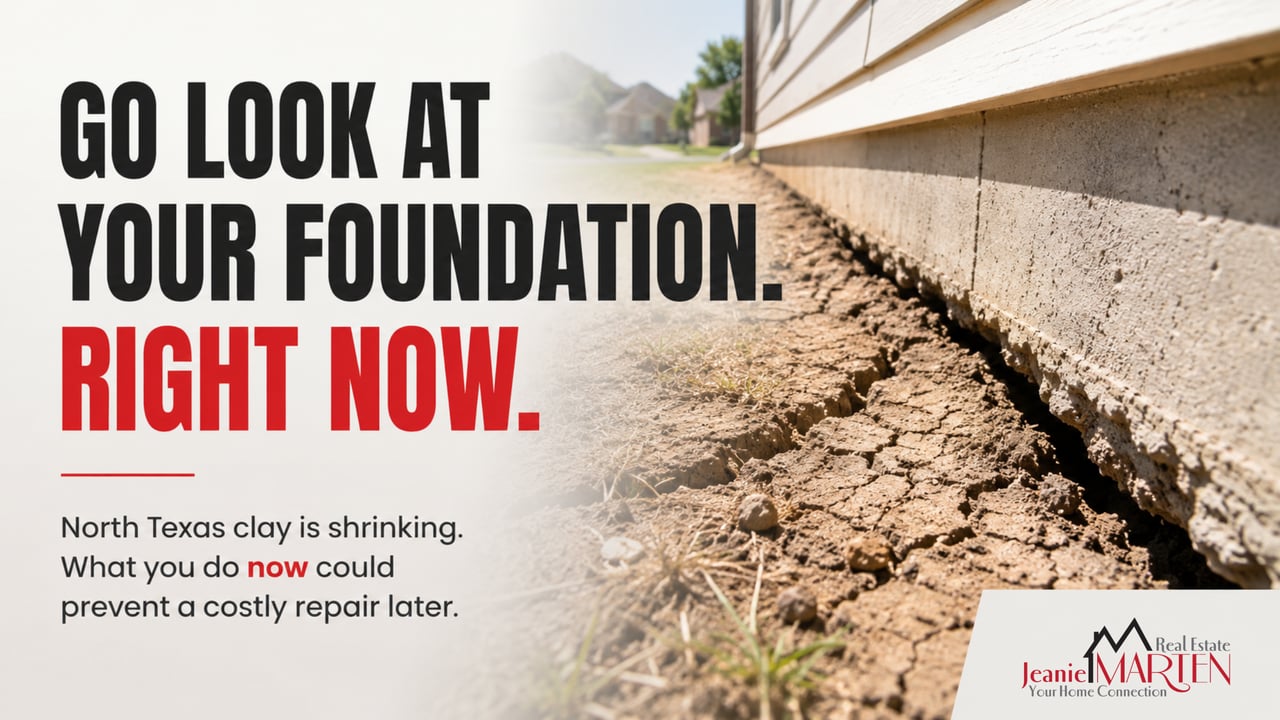
Should I be watering my foundation during a North Texas drought? Yes. After more than three weeks of triple-digit heat, clay soil across North Texas is shrinking and pulling away from foundations. Consistent soaker hose watering now is far cheaper than foundation repair later.
Walk outside and look at the ground where your dirt meets your slab.
If you can see a gap, if the soil has pulled back and left a visible crack running along the edge of your house, your foundation is not sitting on what it was built to sit on. That gap is not cosmetic. It is the beginning of an expensive problem and right now it is forming in yards all over Sachse, Wylie, Murphy and Lavon.
We have been in triple digits nearly every day since the beginning of August, with no meaningful relief in the extended forecast. For context on how unusual this stretch is, North Texas averages roughly 20 triple-digit days in an entire year. We have burned through that and kept going.
This is the post I did not want to have to write in August. Foundation watering is normally something I bring up in September. Waiting until September this year is a mistake.
Why clay does this to your house
Most of us are sitting on expansive clay. It is the defining feature of building in this part of Texas and the reason foundation repair is a whole industry here.
Clay swells when it takes on water and shrinks when it dries out. It does not do this gently. A slab foundation is essentially floating on that soil, so when the clay under one part of your house dries and contracts faster than the clay under another part, the house moves with it. That is where you get the sticking doors, the hairline cracks above door frames, the windows that suddenly will not latch.
The damage is not caused by the heat itself. It is caused by the difference. Soil that stays evenly moist supports the slab evenly. Soil that swings from saturated to bone dry and back is what cracks foundations, and a summer like this one is the swing.
If you want the longer version of what actually matters with North Texas foundations and what people worry about unnecessarily, I wrote about that in Foundations in North Texas: 7 Things That Matter in DFW (and 3 That Don't).
How to tell if yours is already in trouble
Go do these three things today. They take about five minutes.
Look for the gap. Walk the entire perimeter of your house, not just the front. If soil has separated from the slab anywhere, note how wide and how deep. A gap you can slide your hand into is serious.
Try the screwdriver test. Push a long screwdriver into the soil a foot or so out from the foundation. In properly moist soil it should go in with steady pressure. If you cannot get it in more than an inch or two, your soil is dangerously dry.
Check your doors. Interior doors that have started sticking in the last few weeks, or a front door that suddenly needs a shoulder, are telling you the frame has moved.
How to actually water a foundation
Here is where most people get it wrong, usually by being too generous.
Put a soaker hose 12 to 18 inches out from the foundation. Not touching the slab. You are watering the soil that supports the house, not the house.
Run it in short cycles and let the water soak in between them. Texas A&M AgriLife Extension agent Brad Voss made this point in Local Profile and it is the single most useful thing to understand about clay: it absorbs water slowly. Run a hose continuously on dry clay and most of that water runs off or pools instead of soaking in. Short bursts with soak-in time do far more good than one long soak.
Water every side of the house, not just the side you happen to walk past. Uneven watering creates exactly the uneven support you are trying to prevent.
Aim for consistency, not volume. Damp, not muddy. The goal is to hold steady moisture, and steady is the whole point.
Do not flood a gap that has already opened. This is the overcorrection I see most. Dumping water into a wide separation makes the clay swell fast and unevenly and rapid swelling can do its own damage. If you have let it get away from you, restart gently and build the moisture back over days, not hours.
No, the water restrictions are not your excuse
This is the part almost nobody knows and it is why people let their foundations go all summer.
Most of us are served by the North Texas Municipal Water District, which has been under mandatory Stage 2 conservation for an extended stretch. So homeowners look at their assigned two watering days, decide their hands are tied, and do nothing.
Read the rules more carefully. The day-of-week limits apply to sprinklers and automatic irrigation systems. Soaker hoses, drip zones, and hand-held hoses with a shutoff nozzle are treated differently.
The City of Wylie states it plainly in its water restrictions: additional landscape watering may be provided by hand-held hose with shutoff nozzle, dedicated irrigation drip zones, or soaker hose, provided no runoff occurs. That is your foundation watering, and it is not limited to your two sprinkler days.
Two caveats worth taking seriously. The blackout window still applies, so do not run it between 10 a.m. and 6 p.m. from April through October. And "provided no runoff occurs" is a real condition, not fine print. Water pooling on your sidewalk is both a violation and useless to your foundation.
Rules vary by city and by utility district, and some of us in this area are on East Fork SUD or another provider rather than a city system. Take two minutes and confirm with whoever sends your water bill. A $200 fine is a bad way to learn the details.
One more piece of advice
If you find real separation or your doors have genuinely shifted, give us a call. We have trusted professionals that can help you make the best decisions about what to do.
An engineer charges you a flat fee for an opinion and has nothing to sell you afterward unless they are tied to a repair company. Calling the wrong repair company gives you a free inspection and makes money on piers. I am not saying the repair companies are dishonest. I am saying you should know who is being paid for their answer and who is being paid for the work.
Most houses in this heat do not need piers. They need water, applied steadily, starting today.
Frequently asked questions
How long should I run a soaker hose on my foundation? There is no universal number because it depends on your soil, your hose, and how dry things have gotten. The better approach is short cycles with time in between for the clay to absorb, checking the soil until it is evenly damp a few inches down. Damp and consistent beats long and occasional.
Can I water my foundation on a day that is not my assigned watering day? In most North Texas cities, yes, because the two-day restriction applies to sprinklers and irrigation systems rather than soaker hoses and hand watering. Blackout hours still apply and runoff is still prohibited. Confirm the specifics with your own city or utility district, since the rules are not identical everywhere.
Is it too late if my soil has already pulled away from the slab? No, but do not try to fix it in a weekend. Restart watering gently and rebuild the moisture gradually. Flooding a wide gap causes the clay to swell rapidly and unevenly, which is its own risk. If the separation is significant or your doors and windows have shifted, have a structural engineer look at it.
If you found this useful, read these next
- What North Texas Homes Built in the 1990s Need Today (A Real Example: Mine) walks through the maintenance an older North Texas house actually needs, using my own home as the example.
- Your Home Has an Expiration Date covers realistic lifespans for the rest of your major systems, so you know what else is quietly running out of time.
Please go check your foundation today, and tell a neighbor to check theirs. This is the kind of thing that costs nothing to prevent and thousands to fix.
Visit MartenTeam.com or book a consultation.