The Window-Treatment Mistakes Making Your Rooms Look Smaller
Why do window treatments make a room look smaller? Because they decide where your eye stops. A rod mounted on the window casing stops it at six and a half feet. A rod near the ceiling carries it to nine. A valance stops it lower still and cuts the wall with a horizontal band.
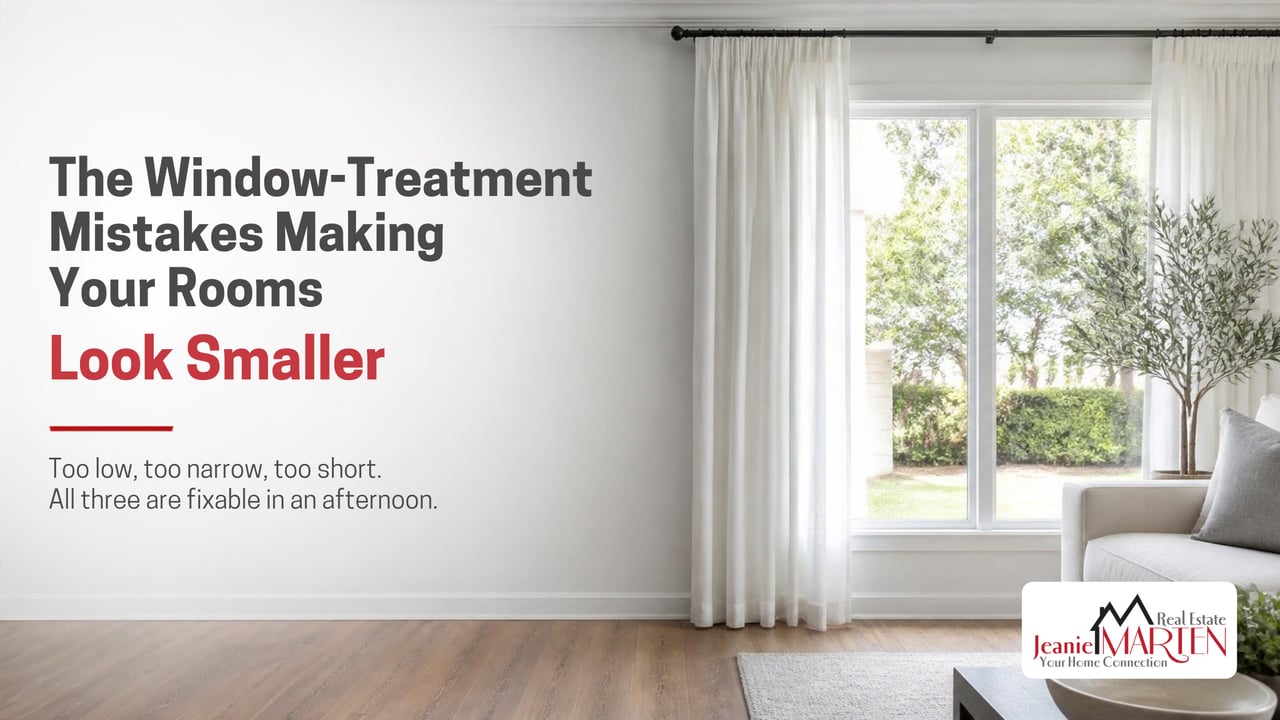
Rooms rarely feel small because of their square footage. They feel small because something interrupts the eye before it reaches the ceiling and in most houses the interrupter is the curtains. The good news is that almost everybody makes the same three mistakes in the same direction. Too low, too narrow, too short. All three are measurable and all three are fixable in an afternoon with a drill and a tape measure.
The Three Numbers Everyone Gets Wrong
Height: 4 to 6 inches above the casing, minimum
The rod does not belong on the window trim. Mount it 4 to 6 inches above the top of the casing and if you have 12 inches or less between the casing and the ceiling, go all the way up instead, within about 2 to 3 inches of the ceiling or crown molding.
This is the highest-impact change on the list and it costs nothing but new anchor holes. The window does not change size but the wall reads taller and the room reads taller with it.
Width: 8 to 12 inches past the casing on each side
Most rods are cut to the width of the window, which means the panels sit on top of the glass all day and block the light you are trying to show off. Extend the rod 8 to 12 inches beyond the casing on each side. Now the panels stack on wall instead of window, the window reads wider than it is and you get every bit of daylight.
While you are measuring, check the fabric. Your two panels together should total roughly 2 to 2.5 times the width of the window so the gather looks deliberate. One skinny panel per side that could never actually close reads as a fabric sample, not a window treatment.
Length: they have to reach the floor
Panels that stop at the windowsill or somewhere in the middle of the wall are the most common version of this mistake and there is a reason. The 84 inch panel is the cheapest and most stocked length in every store so it ends up on a lot of 9 and 10 foot walls in Sachse, Wylie and Murphy, where it looks exactly like pants that are too short.
Rough guide by ceiling height:
- 8 foot ceilings: 84 to 96 inches
- 9 foot ceilings: 96 to 108 inches
- 10 foot ceilings: 108 to 120 inches
At the hem you have three acceptable choices. Kiss the floor, about half an inch above. Float, a half inch up in a traffic path or a house with pets. Or break, with one to two inches of puddle for a softer look. Ending above the floor is not on the list.
The Heavy Valance Is the Fastest Way to Date a Room
This is the one I run into constantly and it is worth its own section.
Box valances with contrast cording and tassel fringe, swags and jabots, balloon valances in a large-scale print. These were the builder and decorator upgrade of roughly 1998 through 2006 and they are doing three bad things at once. They cap the window's visual height at the lowest possible point. They add a heavy horizontal band that chops the wall in half. And the fabric pattern pins the house to a specific decade faster than anything else in the room so a buyer reads the year before they read the space.
Taking them down is easier than people expect. Most are mounted on a board with a handful of screws into the wall or the casing. Two cautions: budget for patching the holes, and expect to touch up paint because the wall behind and above a valance is frequently a slightly different shade or was never painted at all.
What goes up instead is a simple rod hung high and wide with two neutral panels. Or nothing. If the blinds underneath are in good shape, pulling a valance down and hanging nothing at all is still an upgrade.
Same conversation applies to vertical blinds on the patio door, which are the second most dated item in this category. Replace them with a wide roller shade or a panel track or take them off entirely and hang panels on a rod that spans the whole opening.
Panels and rods for a whole house usually run a few hundred dollars which makes this one of the best returns available before a listing. It is the same logic as rug scale, where a rug that floats in the middle of the room makes everything around it look smaller.
Solve Privacy in Layers, Not by Closing Everything
The instinct when a window faces the street or a neighbor is to shut it and leave it shut. That trades all of your light for privacy you only need part of the day.
Layer it instead. A light-filtering roller or cellular shade handles daytime privacy and stationary side panels add softness and height without ever needing to close. Start by deciding what job that particular window has before you shop. A few specific situations:
- Front bedroom on a street: top-down bottom-up shades give you light at the top and privacy at the bottom.
- Window facing a neighbor: solar shades let you see out while blocking the view in during daylight. Know that they reverse after dark once your interior lights are on so they are not nighttime privacy.
- Bathroom: frosted window film costs very little, goes on in twenty minutes, and solves it permanently.
Heat Control Is a Different Problem
West-facing glass in North Texas in August is its own category and it is worth separating from how the room looks.
Interior shades do real work here. Department of Energy research on cellular shades found they can cut heating energy use by up to 20 percent and total home energy use by up to 15 percent compared with bare windows, and save roughly 15 percent of annual HVAC energy compared with vinyl blinds.
Exterior solar screens are more effective still because they stop the heat before it ever reaches the glass. The honest trade-off is that they darken the room and photograph as flat dark rectangles from the street so if you are listing, consider pulling them off the front-facing windows for photos and putting them back after. Check your HOA first, since some regulate screen color.
And do not assume windows are where your money is going. Walls, air leaks and the attic all compete for that title, which I got into in do you really lose most of your home's heat through the roof.
Before Photos and Showings
- Take down every valance, patch the holes, touch up the paint
- Deal with the vertical blinds on the patio door
- Raise every rod, and replace any panel that does not reach the floor
- Keep panels neutral and consistent anywhere two windows are visible at once
- Dust the blinds, replace bent slats, and open everything for photography
Frequently Asked Questions
How high should you hang curtains? Four to six inches above the window casing at a minimum. If there is 12 inches or less between the casing and the ceiling, go within 2 to 3 inches of the ceiling instead. Mounting the rod directly on the trim is what makes a room feel shorter than it is.
Should I remove valances before selling my home? In almost every case, yes. Heavy or custom valances date a house faster than any other soft finish, and they lower the point where a buyer's eye stops. Remove them, patch the holes, touch up the paint, and hang simple neutral panels high and wide.
Do window treatments stay with the house when it sells? Generally, items permanently attached to the house, such as blinds, shades and mounted rods and hardware, are treated as improvements that convey, while the fabric panels themselves are often handled as personal property. The contract is what actually controls it, so if you plan to take something with you, exclude it in writing before the house goes under contract. Jeanie Marten Real Estate is a brokerage, not a law firm, nothing here is legal advice, and TREC rules prohibit brokers and agents from giving it.
If You Found This Useful, Read These Next
- The Right Rug for the Right Room: A Staging Guide for North Texas Sellers is the floor-level version of this same scale problem, with exact rug sizes by room.
- Budget Bedroom Updates That Actually Show Up in Listing Photos sorts bedroom fixes by what they cost, including swapping heavy drapes for light panels.
If you want to know which windows in your house are actually costing you and which ones are fine, that is part of what we walk through before a listing goes live. Visit MartenTeam.com or book a consultation.
Jeanie Marten Real Estate 972-414-0719 | MartenTeam.com